


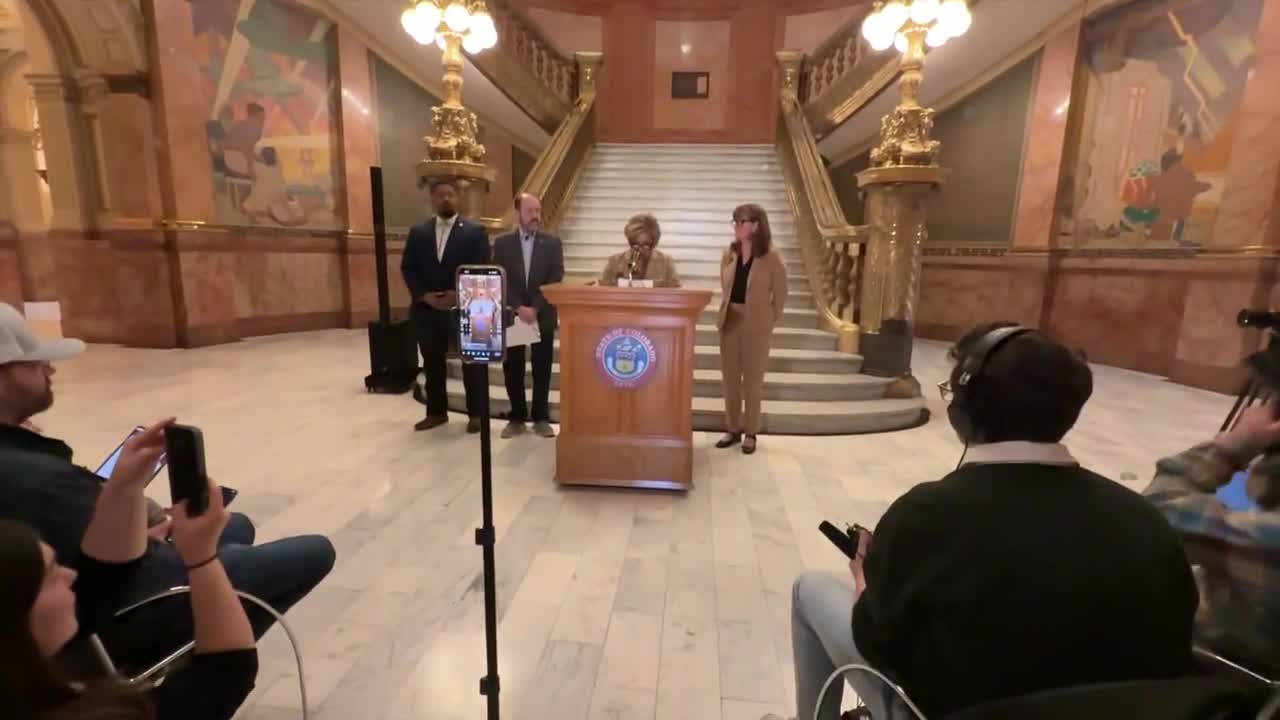


DENVER — Just before the start of the 2026 legislative session, leaders within Colorado's Democratic party came together to discuss their priorities for the 120 days they will spend underneath the Gold Dome — days where a daunting budget deficit will hang over all of their heads.
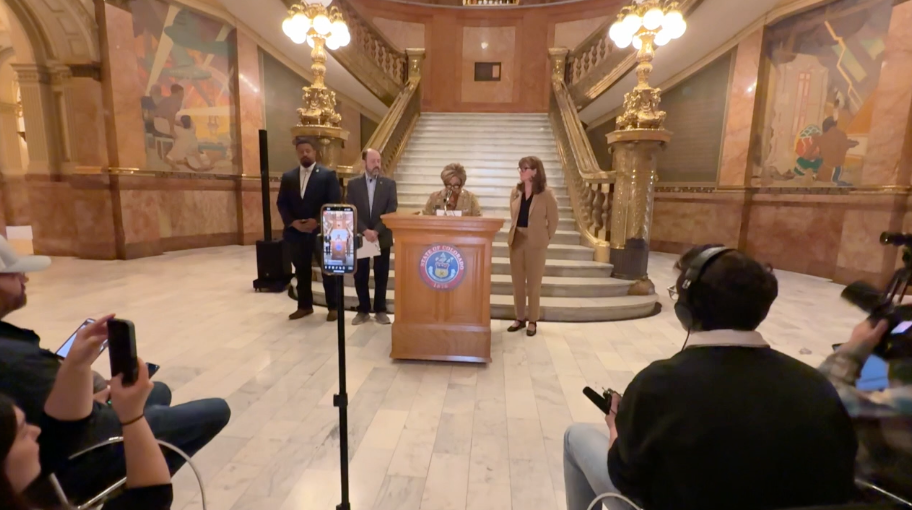
Still, the mood was light as the lawmakers huddled around the podium to speak. Jokes were made, hugs were given, and a feeling of excitement was palpable.
Senate President James Coleman began by addressing the crowd, saying Democrats are focused on growing Colorado's economy, lowering costs, and "meeting the moment to make life better for all Coloradans."
"Over the interim, I was blessed to visit every single Senate District across Colorado, visiting my Democrat and my Republican colleagues on their home turf. I heard from them and their constituents about their lives, their families, what they're worried about and what's important to them. I'm entering this session grounded in these conversations," Coleman said. "Colorado has long been a national leader on consumer protections, clean energy, civil rights, water policy and so much more. And this session, we're ready to continue that leadership and stand up for what's right — no matter what obstacles are thrown in our way."
Coleman said he continually heard constituents address health care when he visited different parts of the state.
“Colorado’s spirit of innovation and entrepreneurship means that a lot of Coloradans get their health insurance coverage through the individual marketplace. Congress' refusal to extend the enhanced premium tax credits has led to skyrocketing insurance premiums," said Coleman. "During the special session this past summer, we acted quickly to pass legislation to blunt these premium increases and stabilize Colorado's insurance market... While only Congress can fix this problem entirely, we will do our best to protect Colorado families from these increases.”
Then came the word Coloradans will constantly hear over the course of the session: budget. Colorado lawmakers are required to pass a balanced budget.
“It's no secret that between budget constraints under TABOR (Taxpayer Bill of Rights) and chaotic federal economic policies, we face another budget shortfall," said Coleman. "Colorado's demographics are changing between an aging population and rising costs of providing health care services. Our state's Medicaid budget has exploded over the years and is a major contributor to our ongoing budget challenges. Our focus remains on preserving funding for critical service services.”

This is the second year in a row that the State of Colorado is facing a budget deficit. During his budget presentation in November, Governor Jared Polis cited the federal government shutdown, tariffs, and H.R. 1 (One Big Beautiful Bill Act) as factors that hurt Colorado's budget, in addition to increasing Medicaid costs.
A special session was held in August to address the state's $1.2 billion budget hole, which was created by tax changes made in President Donald Trump's One Big Beautiful Act (H.R.1). As a result, Colorado will collect less revenue than expected when lawmakers approved the state budget in May.
Some of that $1.2 billion revenue loss was absorbed by the state education fund and the affordable housing fund. Around $300 million that the state had in surplus, which would have been refunded to taxpayers, will now be used to help fill the gap. That left lawmakers with a budget gap estimated to be around $783 million.
Democratic legislative leaders and Polis had a three-pronged approach to address the budget gap:
- Cut special corporate tax breaks
- Dip into the state's reserves
- Make spending cuts
Watch the full press conference with Colorado Democratic leaders in the video player below:
Just after the special session concluded, Polis announced a total of $250 million in cuts and redirected spending in order to balance the state budget.
“As we enter this legislative session, we are not naive to the moment our state finds itself in," said Senate Majority Leader Robert Rodriguez. "Trump's tariffs, budget bills and targeted callbacks of federal dollars continue to put billionaires and corporations first, leave working families, farmers and ranchers and the middle class behind, and threaten our state's core services that help us all thrive.”
“We're facing an uphill battle amid recent attacks from the Trump administration and the federal GOP, including hundreds of millions of dollars in funding for child care, food assistance, job training and other crucial services that keep Colorado families afloat," said House Majority Leader Monica Duran. "These attacks weigh heavily on Coloradans, which is why Colorado Democrats are laser-focused on this session to pass legislation that will drive down costs, especially for housing, health care, energy bills and child care.”
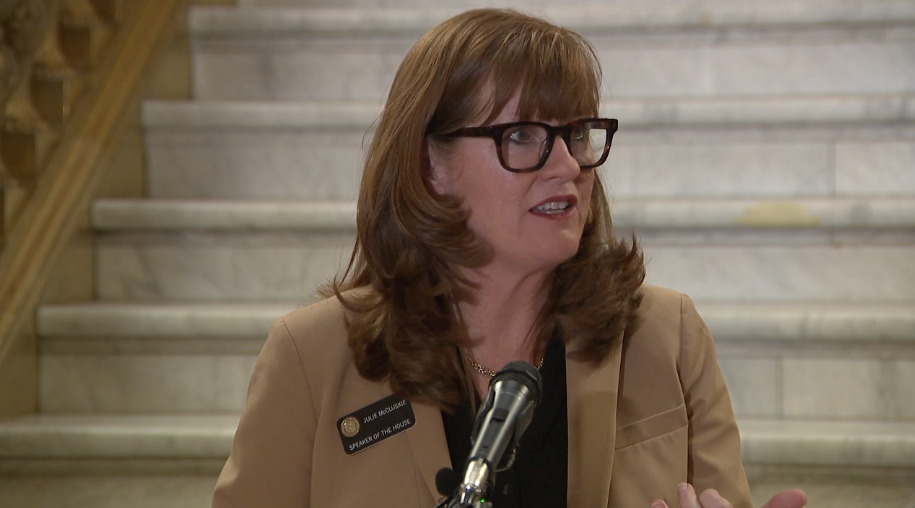
Denver7 asked House Speaker Julie McCluskie if the budget deficit will impact the amount of work lawmakers can accomplish during the session.
"We came together during special session. We were able to decouple taxation with many of our business and industry partners in a way that allows them to benefit from those federal cuts, but protects Colorado's revenue streams. Unfortunately, we dipped into our piggy bank and we cut expenses," McCluskie said in response. "Now, we face another $700 to $800 million shortfall, and none of this is easy. It is certainly challenging in our current fiscal structure to have to deal with these kinds of pressures when we know we have teachers not earning a living wage in the communities — where they are rural, suburban, or urban. It is hard when there are demands for better roads and improvements to bridges, when we don't have the funding to be able to do that.”
McCluskie believes it is time for the state to engage in a "very real conversation" about the Taxpayer Bill of Rights (TABOR) in Colorado, which requires voter approval for the state to keep any revenue collected that exceeds a Blue Book estimate.
"I certainly hope that they [conversations] are led by people in this building and partners outside. When we talk about any type of modernization to a 30-year-old law, we can't do it alone. We need to do it with partners everywhere," said McCluskie. “Everything that we do right now about modernizing the fiscal structure is critically important. Given the challenges we're facing with our budget, we can't ignore it.”

The Chair of Political Science at Metropolitan State University (MSU) in Denver, Robert Preuhs, said the state is currently seeing costs due to inflation in certain sectors that are not accounted for within the TABOR formula.
“The issue that's at hand right now is that our expenditures have outpaced TABOR," Preuhs explained. "Eliminating TABOR is going to give a lot more flexibility to the legislature... Even so, really getting rid of TABOR, politically and practically, is going to require a ballot initiative, or a ballot question. Whether the legislature wants to put that forward, or whether a third party is going to initiate that process, that's really up to the legislature and whether they're willing to really back the removal of TABOR."
Preuhs predicts the budget deficit will limit lawmakers throughout the session.
“It's probably good strategy this year if you need to make a statement to your constituents to propose a policy change, realistically understand that anything that's going to cost the state money is probably not going to make it much past a committee," said Preuhs.

At the press conference on Tuesday, legislators discussed their goals beyond solving the budget deficit as well, which included combating rising energy costs, addressing affordable housing, and tackling the high cost of property insurance.
McCluskie also hinted at conversations that will likely look into whether or not a utility company can be held liable for a wildfire.
Each lawmaker who spoke expressed a similar sentiment: the work they do in the State Capitol will not be influenced by the moves made at the federal level.
“It is going to be a powerful session. We will be standing up to Washington," said McCluskie. "This is our moment to make sure that Colorado remains the fortress that it is in protecting people's rights, people's liberties, and people's freedoms.”
"Listen, I just want to say this, what we do in this building will not be defined off of a federal administration," Coleman said, to close the press conference. "We define what we do with information based off of what's best for the people the State of Colorado. We did work with fear that there would be federal backlash, and in the end, regardless of what we did, we still see there's federal backlash... We're not going to be reckless. We're going to be strategic and tactical. We're going to be listening to our community, our constituents, to the folks who were here in the lobby and the folks who come and do the work here with us — to all of you.”
“What we do is not going to be dictated off of what's happening in Washington," Coleman said before stepping away from the podium.

The mayors of Denver, Aurora, and Colorado Springs wrote a letter to the Colorado General Assembly, detailing what they would like to see addressed during the session as well. The letter states that "issues around competency and mental health, economic vitality, and protecting voter-allocated funding remain the most important concerns facing our cities."
The 2026 legislative session officially begins on Wednesday, Jan. 14.
Republican leaders within the Colorado State Capitol have planned a press availability on Wednesday morning, and Denver7 will share their priorities at that time.
