


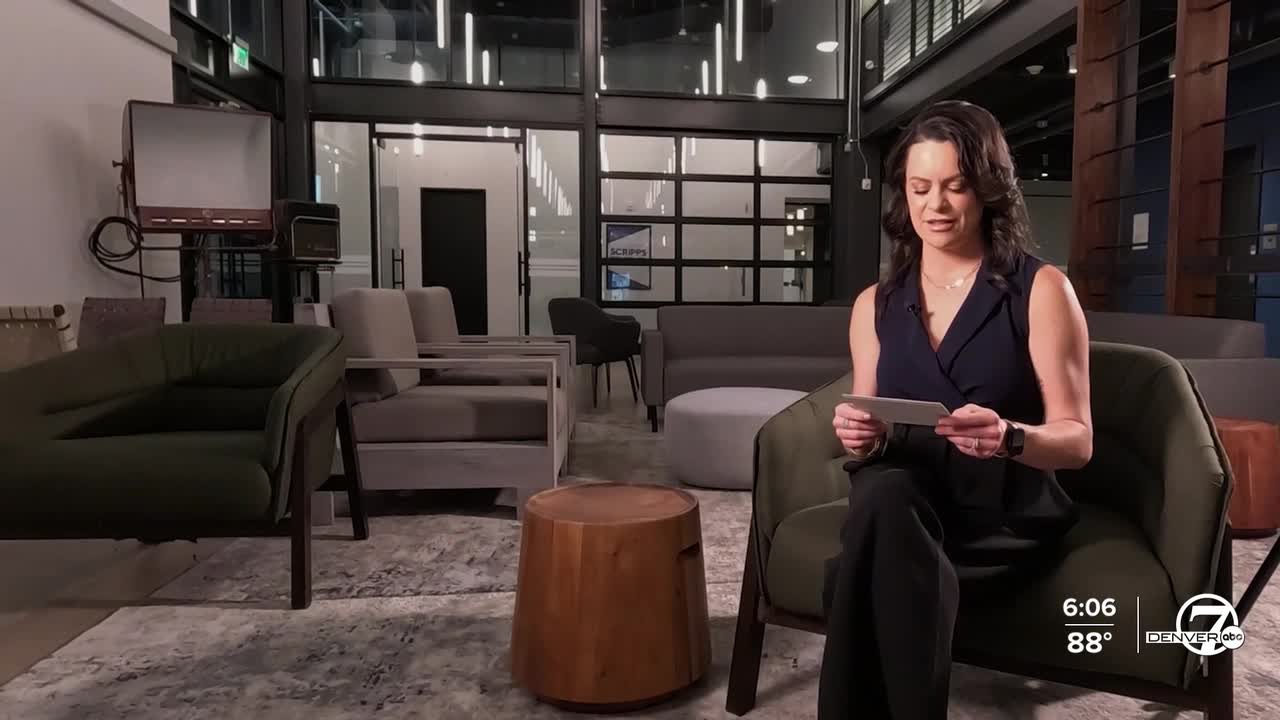


DENVER — A new Colorado law gives certain crime survivors the ability to testify virtually in a courtroom, something one woman who spent years dealing with a stalker believes will make the criminal justice system more accommodating for victims whose testimony is often critical to a case.
Coles Whalen knows how difficult it is to talk through traumatic experiences from the witness stand.
"What people don't realize is that, in a lot of cases, you can be only four feet away from the person who harmed you when you're testifying against them," Whalen told Denver7. "You're forced when you're linked by the law to be in close physical proximity to them, and then in order to prove your case, your task is to describe and to prove that you have suffered serious emotional distress.”
Whalen is a musician and performer who said she was stalked for over six years.
“He was sending me thousands and thousands of messages. One investigator on the case estimated that he sent me about a million messages over the six years," Whalen said. "They ranged in tone from delusional to angry to ultimately very threatening. Many of the messages implied that he was following me, that he was seeing me in person without me knowing it, and that he wanted me dead.”
She was a staunch supporter of Senate Bill 26-095, saying it would have changed the ultimate outcome of her case. The bill was signed into law by Gov. Jared Polis on May 19 of this year.
"If I had this opportunity available to me, my life would be totally different," said Whalen. "I think we're going to change a lot of lives here, and honestly, we'll probably save some lives too."

SB 26-095 allows survivors of domestic violence, sexual assault, stalking, and human trafficking to provide testimony via a closed-circuit television in certain circumstances. The change in Colorado law gives survivors the chance to testify from a place outside of the courtroom, physically removed from the defendant in the case.
"A survivor of crime is almost always a witness, and their testimony is important, may be critical to obtaining the conviction of somebody who has harmed them, and frankly, maybe others," said State Sen. Mike Weissman, D — District 28, who was a sponsor of the legislation. “We've all been doing Zoom, we know how that goes. This is just bringing it to the criminal legal process to protect survivors from being retraumatized.”
In addition, the law implements an Anti-SLAPP (Strategic Lawsuits Against Public Participation) provision to combat lawsuits meant to intimidate survivors. It also changes Colorado law on forced arbitration for sex assault survivors. Arbitration is a way to resolve a case outside of the courtroom.
"Arbitration takes you out of the courts. It puts you into this, frankly, private kind of shadowy alternative dispute process. If people want to participate in arbitration, that's fine. But the problem is, most of it is involuntary," Weissman explained.
There are provisions in the law related to the staggering rape kit backlog in Colorado that was spotlighted during the last legislative session, such as requiring medical professionals who perform forensic examinations to tell individuals how to obtain those test results.
"Going through a SANE exam is incredibly invasive and personal, and it is hard enough to go through that. Frankly, a lot of survivors choose not to. It's just too much," Weissman said. "At the bare minimum, you should be able to get the records. There are legal restraints on the ability of prosecutors, for example, to communicate about those. It's really the medical professionals in the first instance who are in the best position to communicate options, basic awareness, and information to survivors of these assaults. So, we had some language in the bill to try to make that more clear too.”
Weissman said every part of SB26-095 was developed, to some extent, from survivor experience.
"The work of making sure our law does right by survivors of crimes is never done," said Weissman.
He first met Whalen when she testified in support of the legislation before state lawmakers on the Senate Judiciary Committee.
"She had to change her entire life, almost go into hiding, and yet she is so poised and forceful in bringing her story into the legislative environment, which can be intimidating for people," said Weissman. "She did an amazing job, and I think it helped seal the deal for getting support from that committee.”

Politics
Colorado lawmakers advance bill to strengthen protections for crime survivors
From a young age, Whalen knew she was passionate about performing. She first found her voice on stage, and turned her love of music into a career.
Ultimately, her life in the spotlight was shattered by a stalker.
"I spent more than a decade on the road as a professional musician, and during the time that I was performing, I acquired a dangerous stalker," Whalen said. "I got law enforcement involved here in the state of Colorado. We went to trial. He was convicted by a jury, and he was sent to jail for four and a half years for stalking.”
According to Whalen, that Arapahoe County trial was in 2017. She thought once her stalker was behind bars that she would return to center stage, but found it incredibly difficult to do so.
"I was experiencing terrible stage fright, horrible anxiety, and it started to feel so bad to perform that I had to step away from the stage," said Whalen. "I left the state of Colorado. I couldn't really get a sense of safety here. I did many years of therapy. I worked with a lot of trauma specialists, and I started to put the pieces of my life back together and heal.”
Whalen was not prepared for what happened next, when the U.S. Supreme Court reexamined her case in 2023.
"The court ruled that a victim's fear alone was insufficient, and they required proof that the perpetrator knew that the messages that he was sending could be received as threatening, and they vacated the conviction," Whalen explained. "They ruled that the messages that he had sent to me over those years of my life, as threatening as they were, were actually protected free speech.”
The case could have been retried in Colorado, but Whalen said it would require her to take the witness stand once again.
"I could not go back to trial after everything I had been through. The one thing that I could not do was testify in person in front of the stalker again," Whalen said. "This time, [prosecutors] were required to prove that he knew that the messages that he sent could be received as threats, and so without my testimony, the state had no case, and they dropped the case. The record was sealed. If you call the State of Colorado today, they'll tell you there was no crime committed, and it seems just so unfair.”
Whalen said she could not bring herself to testify in front of the defendant for a second time.
"In my case, he was loudly reacting every time I said that I didn't know him or that I was afraid of him. He's making physical gestures and using his voice to, kind of like, imply disgust, and that's so traumatizing," Whalen said. “It's so invasive, and it's just so difficult. Such a difficult experience to have to go through.”
She desperately wanted another conviction for her stalker, but was faced with what she called an impossible decision.
"If I had the option to testify remotely, I would have gone back to trial," Whalen said. "After I decided not to testify, I thought to myself, why do we have to testify in person?”
That led Whalen to advocate for SB26-095, saying it will shield future survivors from avoidable trauma.
She told Denver7 she recently spoke at the National Crime Victims Law Conference, where she discussed the new Colorado law. According to Whalen, representatives from eight other states approached her to discuss how to enact similar laws.
"It is a really incredible feeling knowing that my voice was silenced by this crime that happened to me, and it's now coming back. I'm using it in a different way," said Whalen with a smile. "Maybe my voice is not heard in quite the same way that it was when I was touring the country and performing night after night, but it's still being heard and it's still making an impact, and I'm really proud of that."


Denver7 is committed to making a difference in our community by standing up for what's right, listening, lending a helping hand and following through on promises. See that work in action, in the videos above.