


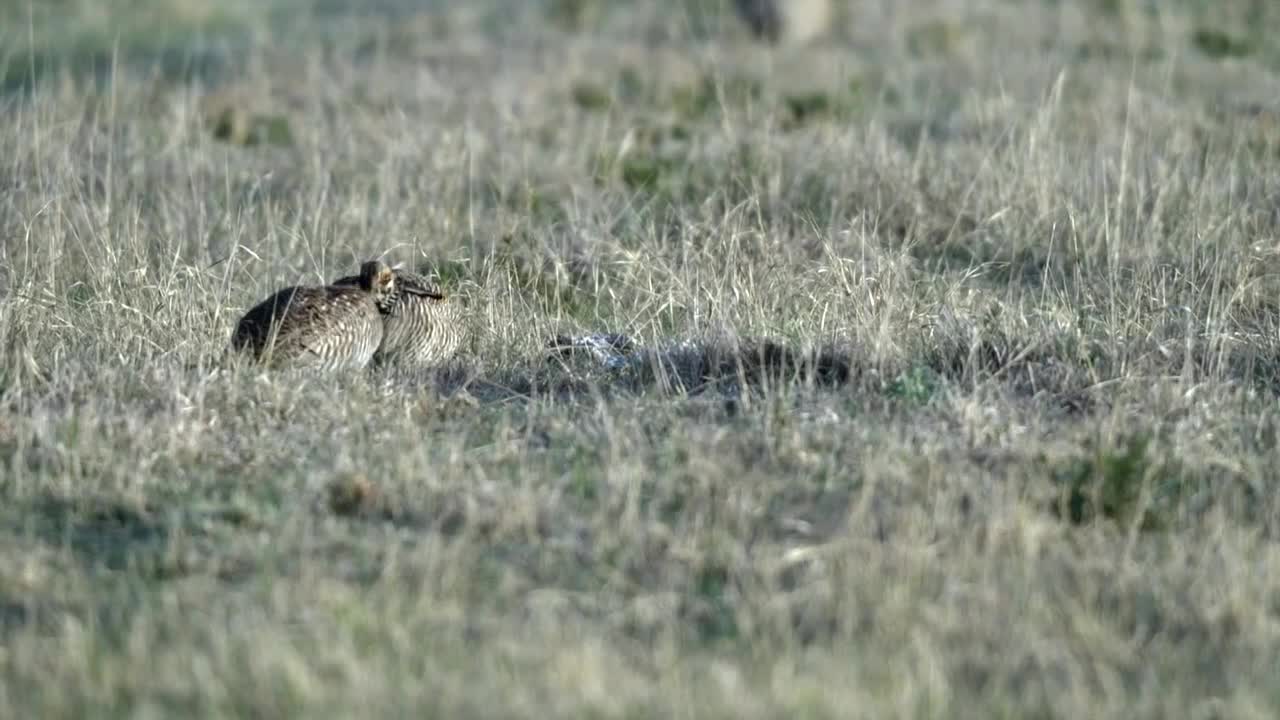


DENVER — As the sun rose on a chilly morning near the Colorado-Kansas border, a group of men huddled up in a wildlife observation blind and waited in silence.
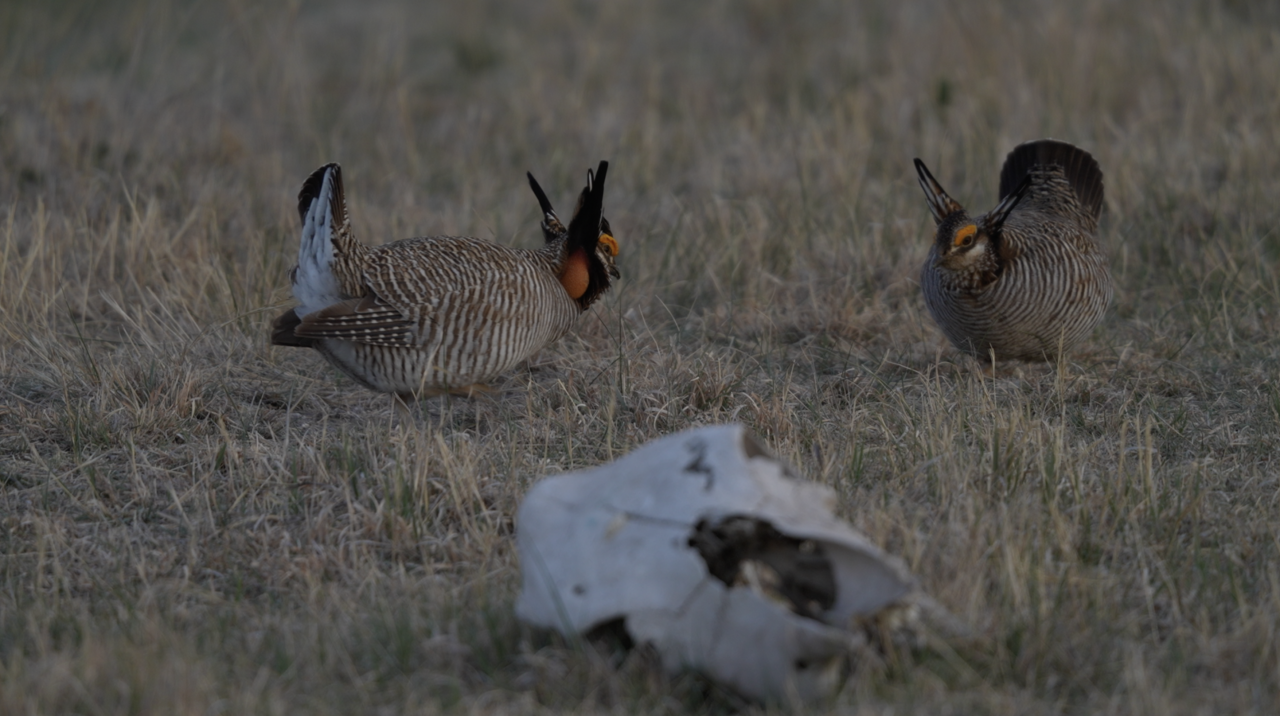
Soon, the tall grass ahead of them began moving, ever so slightly, and a small bird emerged. The lesser prairie chicken, with orangish eyebrows and reddish air sacs on their neck, was quickly joined by a handful of other males. The group of birds began "booming," a noise that is specific to their annual mating ritual.
- Watch the full story in the video player below.
The men in the blind watched excitedly as the birds began to squawk and square off against one another — even though there was no female lesser prairie chicken in sight. After a little less than a half hour, the birds all departed simultaneously, with one of the men guessing that they must have spotted one of their predators, a hawk.
"We were watching a lek display, as they call it. And a lek is where they do their mating dance," said Adam Riggsbee, the CEO of LPC Conservation. “Usually, several males will get together. They boom, as they call it. They do a dance. A female, if everything goes right, will come in, and she will hop around until she finds a male that, you know, has the right boom, I guess. And then that's when the mating happens.”
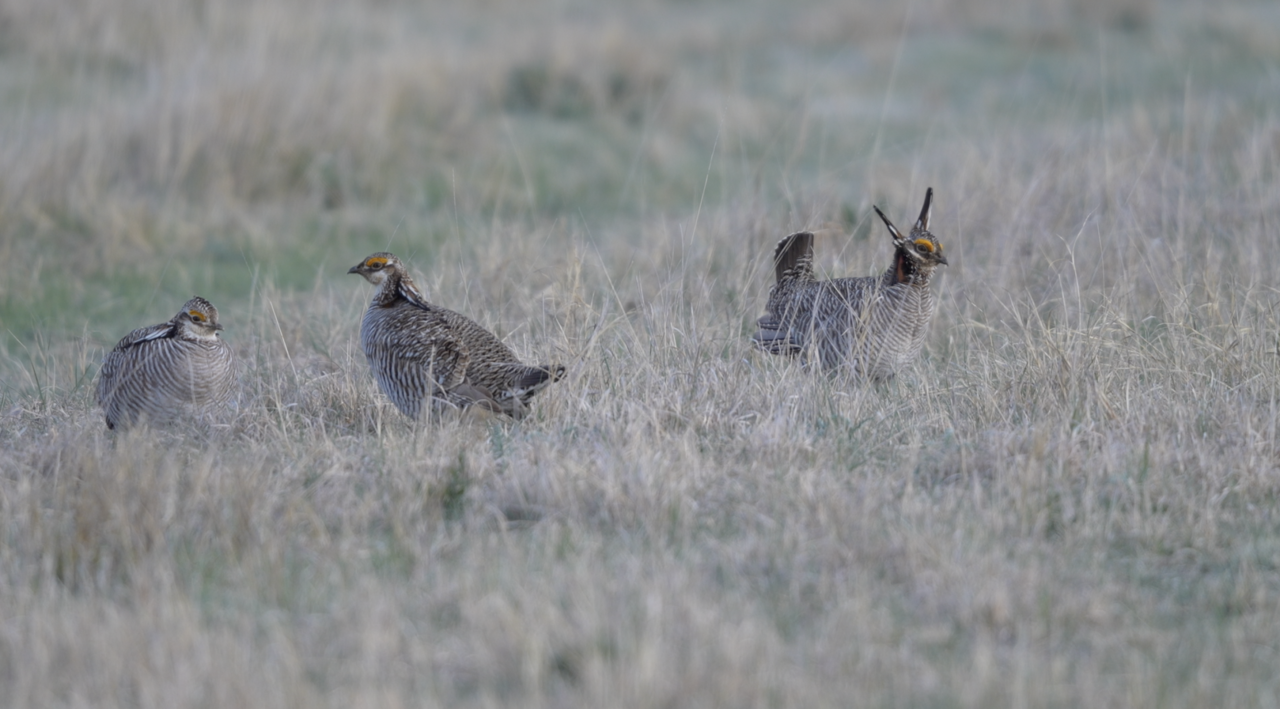
Riggsbee traveled to see the birds on the Hoeme Ranch in Kansas, where people come from all over the world to observe the wildlife on the property.
“It's iconic. It's showy. You don't necessarily see them very often. You actually have to wake up crazy early," Riggsbee said about the lesser prairie chickens. “It's really a memory that you'll have for the rest of your life.”
The U.S. Fish and Wildlife Service removed the lesser prairie chicken from the protections it had under the Endangered Species Act (ESA) in February.
However, Riggsbee does not believe the bird has rebounded sufficiently to be delisted.
“The numbers aren't getting better," Riggsbee said. "Colorado would be the first state to pass a law that protects the bird within its own borders.”
Certain Colorado lawmakers are working to address how to handle this moment that connects the bird, ranchers, and renewable energy production, as the 2026 legislative session quickly comes to a close.
There are less than 100 breeding male lesser prairie chickens estimated in Colorado currently, where the bird is considered a threatened species.
“It's not a chicken, even though it's called a chicken. It's actually a grouse," Riggsbee said with a smile.
Lesser prairie chickens reside in Colorado, Kansas, Oklahoma, Texas, and New Mexico.
“The lesser prairie chicken is a single species, but if we get that right and we can protect that bird, we're protecting this healthy prairie and all the other wildlife that comes with it," Riggsbee said. "The work's important because we just don't have much prairie left... This is one of the most threatened ecosystems in the world."
The Hoeme Ranch in Kansas spans roughly 9,000 acres of grassland, where Stacy Hoeme said the way he grazes his cattle is critical to the survival of the lesser prairie chicken.
"You have to graze pastures to get good soil health and good grass health, and that brings everything back," said Hoeme. “It's a combination of everything. And if you do all that right and have a lot of habitat, the birds do really good.”
Hoeme estimated there are almost 100 male lesser prairie chickens on his property, roughly the same amount of male birds in the entire state of Colorado.
“You've got to save ranching to save the chickens. And that's honestly where we're at," said Hoeme.
“We can use the lesser prairie chicken, we can use the renewable push in Colorado, to re-incentivize investment into the prairies and bring the prairies back to Colorado," said Riggsbee. "We can have renewable energy and have wildlife and have intact native prairies. It's doable.”
Riggsbee said Colorado should act now, since the lesser prairie chicken has been removed from its federal endangered status.
"It would effectively regulate the loss of chicken habitat and require offsets for that chicken habitat. So, for every acre we lose to a transmission line or a wind farm, we gain two more in Colorado," Riggsbee explained. “That's a real opportunity for Colorado... because it's off the list. They [U.S. Fish and Wildlife] have no authority to regulate the chicken. Colorado can step in, pass its own law, regulate the resource within its own borders, and make sure that the offsets are in Colorado. So, these are Colorado ranchers being paid by Colorado rate payers to conserve prairie land.”
According to a letter sent to the U.S. Fish and Wildlife Service from the Director of Colorado Parks and Wildlife (CPW) in March, the lesser prairie chicken population in southeast Colorado is "perilously low."
The letter went on to say that "despite decades of collaborative management between CPW, private landowners, federal agencies, and conservation partners," the number of lesser prairie chickens in Colorado has continued to decline. The Director of CPW, Laura Clellan, wrote that the "constantly shifting federal status" of the bird has "undermined progress" when it comes to supporting the conservation goals for the species.
In closing, Clellan encouraged the federal government agency to "heavily lean on the expertise and judgment" of state collaborators when it comes to the Lesser Prairie-Chicken Species Status Assessment.
State Sen. Dylan Roberts, D — District 8, first learned about the lesser prairie chicken when it was delisted.
“We have this weird dichotomy here in our state, where our state laws and regulations are going to require us to continue preserving habitat for the lesser prairie chicken, but the federal government has taken them off the list," Roberts said.
One of the primary threats to the bird is habitat loss. Roberts explained that the change in federal status for the lesser prairie chicken could lead to energy or agricultural development on the land they call home.
"There's some tension between folks who want to see more renewable energy development in Colorado and preserving some of this landscape for the lesser prairie chicken habitat," said Roberts. "Green energy and renewable energy projects are more intensive on the surface level, which is where the chickens are, and so that's what we're trying to work out.”
Still, Roberts believes there is a way to have renewable energy production, support Colorado ranchers, and protect the lesser prairie chickens.
"What I really care about, either way, is creating a win-win scenario where landowners can still get the incentive to preserve some of their land for this prairie chicken, and then allow them to have incentives to make them more successful with agriculture or with energy development or with commercial building or residential building development," said Roberts. “In all likelihood, with the next administration, the animal will get put back on the Endangered Species list, and if we have decimated their habitat here, then we face all types of financial and legal penalties that landowners in southeast Colorado should not have to deal with.”
Roberts had hoped to put a protection for the lesser prairie chicken in a piece of legislation already moving through the Capitol that is focused on species conservation. However, on Monday, the Chair of the Senate Agriculture and Natural Resources Committee told Denver7 the best option at this point in the legislative session would be a late bill.
He called a late bill "unlikely" at this point. The 2026 legislative session concludes on May 13.
"Technically, a bill can pass in three days. Here, this bill would take longer than that," Roberts said. "Of course, we are having the conversations that would normally happen even if a bill were introduced. So, if and when we get to the point where a bill is introduced, I think it will mean that we got to a good place in those conversations. Otherwise, we'll have a very robust conversation over the interim. We'll try to engage more stakeholders and be back here at next year's session with a piece of legislation.”
In April, the Colorado State Board of Land Commissioners approved the 2026 Lesser Prairie-Chicken Stewardship Action Plan, which lasts for five years and stretches over more than 84,000 acres of state trust land in the southeastern portion of the state. Specifically, the plan applies to land where lesser prairie chicken habitat and active agricultural operations meet.
Key strategies in the plan include protecting specific areas from energy development, utilizing adaptive grazing practices, and exploring incentive-based conservation programs.
The 2026 Lesser-Prairie Chicken Stewardship Action Plan was implemented immediately, requiring annual monitoring and reporting to track improvements, engagement, and effectiveness.
I am in Lamar today to see one of the most amazing birds we have here in Colorado. The Lesser Prairie Chicken calls southeastern Colorado home, and we are taking action to protect their habitat, regrow vegetation in the area, and help support the population. Thank you to Colorado… pic.twitter.com/95Xx3lPT6g
— Governor Jared Polis (@GovofCO) April 10, 2026
Roberts said he has been in communication with Governor Jared Polis' office about how the state should proceed with the lesser prairie chicken.
"We've been talking a lot to his office and the folks that work for him in this field — they know that it's an issue. They know that Colorado has a responsibility to preserve some of this habitat and that we should do what we can to ensure ourselves against further changes in the future," Roberts said. "But he [Polis] also has a big emphasis and priority on more renewable energy, and so I want to try to get us to a place where that's not an exclusive conversation, where we can have both. I know we can.”
Denver7 reached out to Polis' office and requested an interview about the lesser prairie chicken and renewable energy production. A statement was provided instead, which said in part that Colorado "is working to support responsible recreation around important habitats" that the birds call home.
Read the full statement below:
The Lesser Prairie Chickens are native to Colorado’s Southern Plains, and these beautiful birds are part of a balanced ecosystem here in Colorado. Colorado is working to support responsible recreation around important habitats so all who call Colorado home are protected and have healthy habitats to repopulate and be around for future generations.


Denver7 is committed to making a difference in our community by standing up for what's right, listening, lending a helping hand and following through on promises. See that work in action, in the videos above.