



DENVER — One issue on the ballot this November involves re-directing already existing sales tax revenue from sporting equipment and using that to fund wildfire risk reduction efforts. However, environmentalists are speaking out against how the funding would be used, if passed.
Supporters estimate Proposition 137 could bring in $175 million annually without raising taxes. This would result in lower TABOR refund checks in some years.
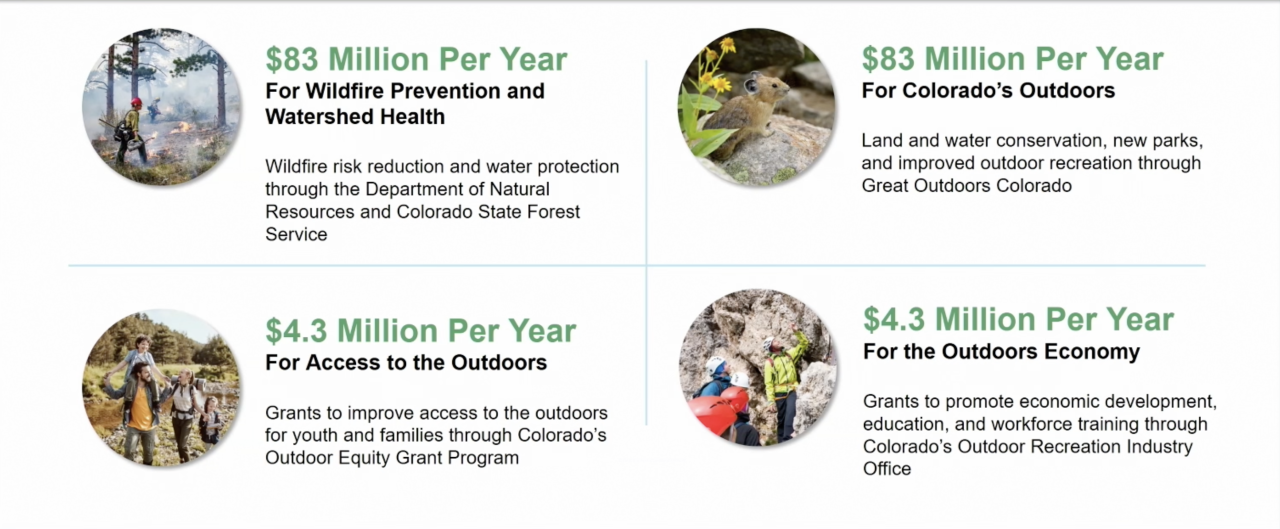
If approved by voters, 45.7% would go toward four existing grant programs for watershed health and wildfire prevention. Another 45.7% would go to Great Outdoors Colorado (GOCO), 2.5% would help fund Colorado's Outdoor Equity Grant Program, and the final 2.5% would go toward Colorado's Outdoor Recreation Industry Office.
"Prop 137 directs, on a percentage basis, the amount of money — which is about $175 million per year — into existing tried and tested grant programs," said Tarn Udall, attorney with Western Resource Advocates and part of the "Yes on Prop 137" campaign. "These have strict guardrails in terms of how the money is spent and accountability measures built in through mechanisms like board oversight and audits."
"We need to realize the value of our forests. The forests are just extremely valuable for all all sorts of things: For wildlife, for watershed, for wonderful recreation, for storing carbon to mitigate climate change," said Rocky Smith, a member of opposition group: "Vote No on Prop 137," an environmentalist and forest management consultant. "Cutting them down in the name of protecting homes, which is a bogus reason, is not going to help, and it's going to wreck our forests."
He and other organizations are speaking out against Prop 137, specifically the types of mitigation work that could be included in some of the potential projects, including fuel reduction and forest thinning.
"The funding that does go to fuel reduction through these programs is aimed at protecting communities and property and life through the removal of vegetation and fuels," said Udall.
Udall describes fuel reduction and forest thinning, as habitat resilience, while the opposition claims it is logging.
"[Supporters of Prop 137] are not calling it 'logging,' but you're calling it 'logging.' Help us understand why," asked Denver7's Danielle Kreutter.
"You cut trees — it's logging," said Smith. "If you log a forest, one of the things you do is expose it to sunlight and wind, which means it dries out faster."
Supporters of Prop 137 told Denver7 they want to be clear; none of the projects that would be funded by this measure, if passed, would be commercial or industrial logging.
"If a project rises to the level of being funded because it's going to protect property, infrastructure, and life, these programs can be used to cut trees. [The trees] will mostly be small in diameter, in dense areas, often diseased, with no commercial value. If somebody has the perspective that to thin the forest, to cut a tree, is logging, then that may be a reason to claim that Prop 137 is about logging. But I think the facts are very clear. It's not supported by the logging industry. These projects are focused on protecting communities in the built environment," said Udall.
Proponents of 137 say they support the concept that when forest thinning is paired with other tools like prescribed burns, the severity of wildfires can be significantly reduced. They said that would help firefighters do their jobs more safely and protect homes while maintaining forest and watershed health.
Some environmentalists challenge the benefit of that type of mitigation and say the funding could be better spent elsewhere.
"No money from 137 is likely to be used for what is called 'home hardening.' Protecting the home ignition zone up to 100 feet around in the home itself," said Smith, "We say, if you're worried about fire, the impact on homes and other infrastructure, treat the area around the homes and the infrastructure."
Election Day is November 3.
Read the full ballot language here or in the embed below:


