

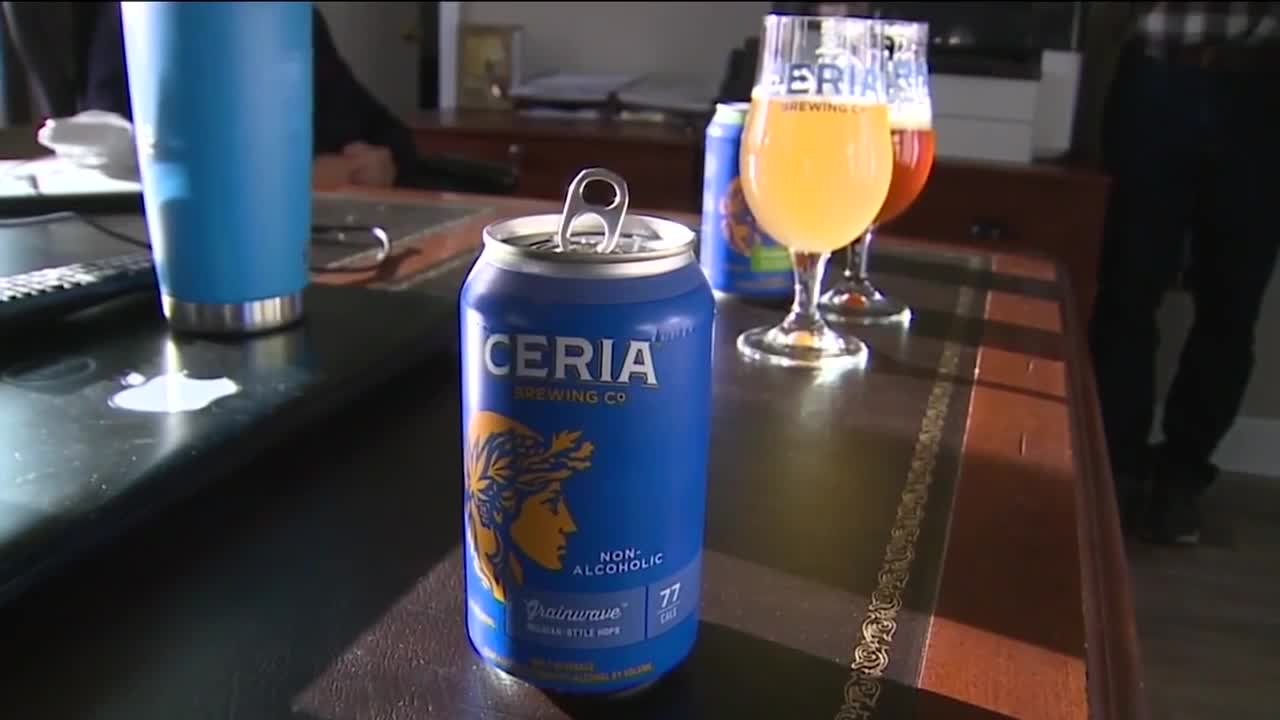


DENVER — Imagine going to a bar or restaurant in Colorado, and on the menu alongside the craft beer are drinks infused with THC.
A push for increased access to such beverages is being considered inside the Colorado Capitol, sparking a debate that is no stranger to the first state that legalized recreational cannabis for adult use.
▶️ WATCH: Denver7's Colette Bordelon talks with supporters and opponents of the bill
Proponents of the bill believe it advances the regulation of THC products in Colorado while creating a new source of tax revenue, but opponents fear it is going further down a problematic path.

Senate Bill 26-164, introduced just a few days before the high holiday that is 4/20, defines a lawful tetrahydrocannabinol (THC) beverage as a nonalcoholic drink that contains a maximum of 10 milligrams of THC per serving. The THC must be derived from a legal source of hemp.
In order to sell the drinks, a permit would have to be obtained first. Licensees would only be legally allowed to sell the beverages to people older than 21, and the THC drinks could not be mixed with alcohol.
"There's a couple dozen states that have THC drinks, low-dose THC drinks available at bars, restaurants, concert venues, places like that," explained Brian Vicente, who spearheads a law firm that works on cannabis and psychedelic issues in Colorado. "Colorado currently has very low-dose THC drinks available at those same venues. So, we're trying to just raise the THC milligram level to five or 10 milligrams, which is more in line with what other states have.”
Vicente was one of the authors on Amendment 64, the measure Colorado voters approved in 2012 that legalized recreational cannabis. He explained that the state currently allows drinks that contain a limit of 1.75 milligrams of THC in places like bars and restaurants.
“What other states have found is consumers want more of a five to 10 milligram drink," said Vicente. “There would also be mandatory training for individuals, bartenders and others that were selling these THC drinks."
The increased level of THC in drinks, up to 10 milligrams, could be sold at bars, restaurants or concert venues in Colorado. Grocery or convenience stores would have a limit of three milligrams per serving, a reduction from the other spaces where the drinks would be sold.
“You have kids and others that access grocery stores," Vicente said. "Of course, it would be illegal for them to steal these substances, but it might make more sense, as we are rolling out this law, to start at a lower level in grocery and convenience stores, and a higher level in liquor stores and build upon that."
According to Vicente, the new drinks infused with THC would generate millions of dollars in tax revenue for Colorado.
“The permits themselves would not be prohibitively expensive for restaurants and bars. The real revenue, which could be as high as $55 million in new revenue, will be produced on tax," said Vicente. "It'd be a 10% excise tax and 10% sales tax and then 2.9% typical state tax. So, we're looking at about 23% state tax.”
State Sen. Julie Gonzales, D — District 34, is a prime sponsor of SB26-164.
"When this idea was first presented to me, I thought, 'Wow, this would be a win-win situation for everyone involved,'" Gonzales said. “Both creating millions of dollars in potential revenue to help address our structural deficit, but then also creating new opportunities and avenues for these beverages to come to the market.”
Gonzales said other states have proven there is a desire from consumers for such products that contain more THC.
"When the current statute allows 1.75 milligram products to be sold, there's just not that demand or that incentive from the industry to be able to bring those products to bear," said Gonzales. “Why not actually introduce legislation that then allows a broader array of these products to be regulated and sold in a safe manner, that then also helps address our structural deficit?"
While Colorado is typically thought of as a pioneer in the cannabis space, Gonzales said the state is playing a game of catch-up with this new bill.
“There are some challenges that actually come with being the first," Gonzales said about Colorado being the first state to legalize and implement the sale of recreational marijuana. "As a state, I would argue, we over-regulated cannabis and now we've seen other states that have learned from our example and have been able to strike that right balance.”
One Chance to Grow Up is an organization that opposes SB26-164.
"We focus on protecting kids from the impacts of today's marijuana," said Rachel O’Bryan, the co-founder and strategic projects director of One Chance to Grow Up. "This is an explosion in retail outlets for where we're going to sell marijuana in our state.”
O'Bryan believes products like THC drinks belong in "severely age-restricted, regulated locations."
“We've had a system where we said, 'Colorado wants to do this, but we're going to keep it away from kids.' This bill will bring it front and center, in front of kids," said O'Bryan. "It's about kids. These bars and restaurants and these convenience stores are located all over the state and close to schools.”
In addition, O'Bryan is concerned there is not time to adequately debate this bill when the legislative session concludes in mid-May.
“Our children are part of this population. They deserve to be a consideration when we look at these bills," said O'Bryan. “Now, we're going to add THC to all the outlets where alcohol is sold, and we know that kids can get their hands on it.”
Gonzales said supporters of the bill have considered how children may be impacted by this potential change in the law.
“We all want to ensure that young people are not allowed access to any of these products, and we have a well-established system within the alcohol industry to ensure that there are not young people who are gaining access to these products," Gonzales said. “We actually look to those best practices. How is the alcohol industry keeping these products from getting into the hands of young people? How might we replicate and then strengthen those protections when it comes to these THC beverages?”
Manufacturers of the drinks would have to register with the Colorado Department of Public Health and Environment (CDPHE), and the beverages could only be sold to licensed wholesalers, not directly to a bar, restaurant or consumer.
CDPHE would be responsible for creating rules on labeling, packaging, and consumer notice requirements for the beverages by the start of 2028.
SB26-164 is scheduled for the Senate Finance Committee on April 28.


