


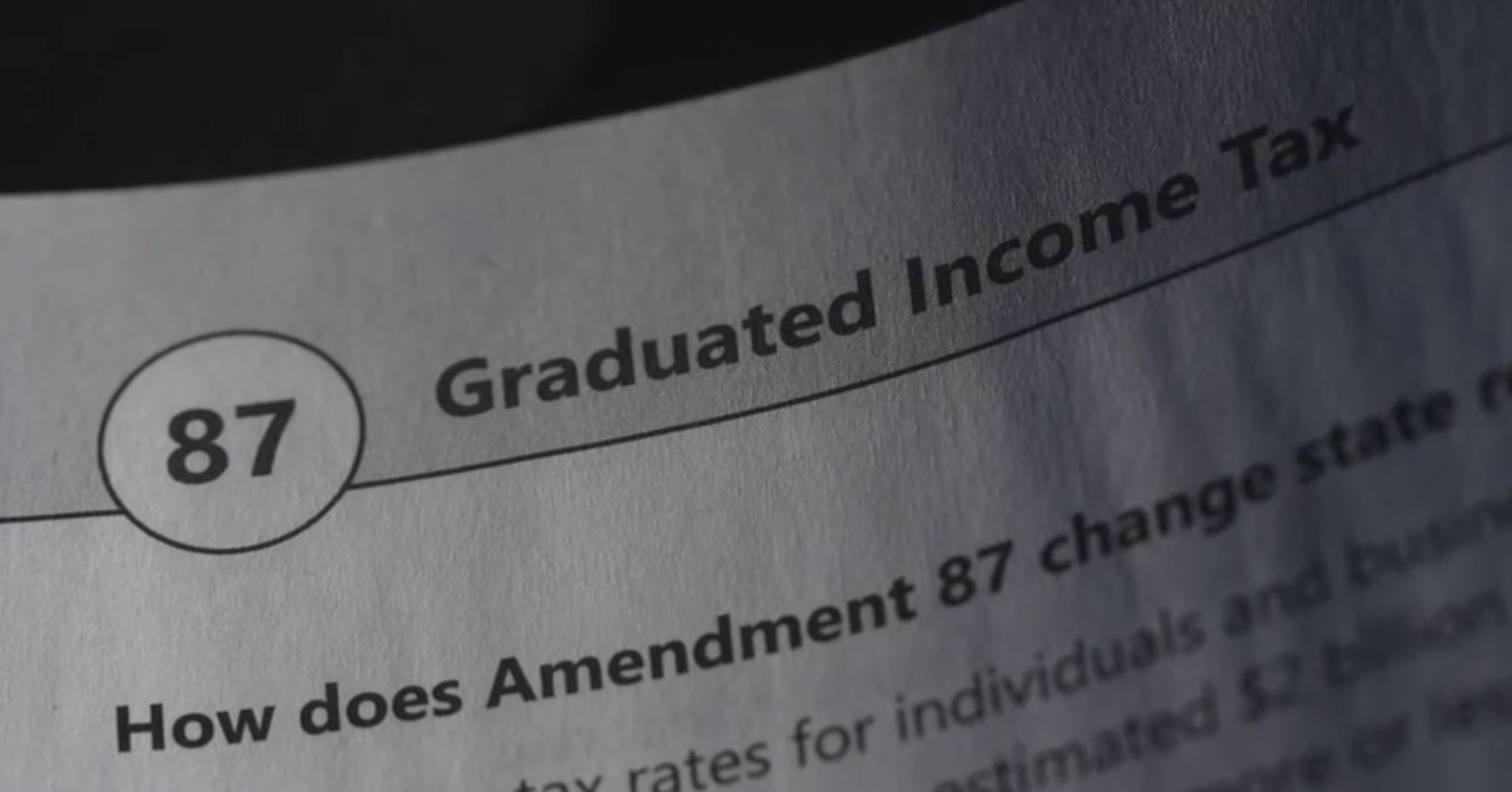


DENVER — While the state waits to learn how a Denver judge will rule on a case challenging the way a controversial proposal qualified for the Nov. ballot, Denver7 spoke with two prominent Democrats who disagree on the measure that aims to implement a graduated income tax in Colorado.
"Of all the amendments on the ballot, this is really the most dangerous for Colorado," said Gov. Jared Polis. "Amendment 87 would double tax rates for businesses."
"I don't love the way overall that it's set up, but I do think fundamentally folks that make more than a million dollars should pay a higher percentage of their income in taxes, and I think that is a fairly noncontroversial opinion here in the state," said Democratic State Sen. Jeff Bridges, who is running to become the next State Treasurer.
While the individuals interviewed for this story cannot comment on the pending lawsuit — which is awaiting a decision from the judge before the end of Wednesday, Oct. 21 — they explained their reasoning for either supporting or opposing Amendment 87.

According to the 2026 Blue Book, Colorado has had a flat income tax rate since 1987, meaning all individuals and businesses throughout the state pay the same 4.4% rate. Amendment 87 would remove the constitutional requirement that the state income tax be set at a single flat rate, and would instead institute a graduated state income tax which sets lower rates for lower incomes, and higher rates for higher incomes.
The proposal claims that additional revenue collected would be spent on K-12 education, health care, and early childhood care or education.
A "yes" vote on Amendment 87 creates a graduated income tax in Colorado by 2027, while a "no" vote maintains the current constitutional requirement for a flat state income tax rate.
Amendment 87 would lower taxes for individuals and businesses making less than $500,000 a year, while raising taxes for those who make more than $500,000 a year. It seeks to create six ranges, called brackets, with higher tax rates as income increases.
Renny Fagan, a former Democratic Colorado lawmaker, said his very first legislative session coincided with Colorado adopting the flat income tax rate. Prior to that, the state had operated with graduated rates during its first fifty years.
"The legislature did that for several reasons. The year before, the federal government passed sweeping tax reform that made lots more income taxable by eliminating credits and exemptions," Fagan explained. "In exchange for that, lowered the rates, particularly on the upper incomes, so the spirit at the time was tax simplification.”
Fagan said the argument was ensuring everyone paid the same rate.
"Over time, it became clearer in the numbers — and very soon after that — that the burdens of everyday living fall greater on the middle class. The burdens of food, child care, insurance, everything we see today," Fagan said. “My last year in the legislature, 1992, I introduced a bill to bring back the graduated tax, which did not pass. And that same year, voters adopted TABOR, which eliminated the legislature's ability to raise taxes and fixed in place in the Constitution that all income must be taxed as a single rate.”
More than 30 years later, Fagan still believes in graduated income tax rates for Colorado, saying it is a more equitable approach.
"The money raised from Amendment 87 goes to K-12 education, healthcare, childcare, things that create a thriving workforce, a great workforce, strong communities. That's what creates a strong business climate," said Fagan.
Polis falls on the other side of Amendment 87, calling it misleading while still saying he supports progressive taxes.
“Anybody who cares about having good jobs, who doesn't want prices to go up even more, should vote against Amendment 87 in Colorado. That's whether you're a Democrat, Republican, unaffiliated," Polis said. "I am worried because the way it looks in the small print version of it... people are going to be tricked into thinking, 'Oh, it's mostly for individuals.'"
Denver7 asked Polis if Amendment 87 would impact his own finances and if that affects his opinion on the matter.
"I should pay more taxes. The wealthy should pay more taxes. There's no question about that. I don't think I earn enough to be in the realm that would pay more taxes under that one," said Polis. "I've really focused on what it does for businesses. That's what people don't realize. Over 70% of this tax hike is on small and medium businesses."
Polis believes other states would take advantage of Colorado if voters approve the measure.
"Utah has a very similar tax rate to what we have. If ours is double, we can't compete for businesses," Polis told Denver7. "It's game over. We will not be able to attract new employers to Colorado if the voters adopt this.”
However, Bridges told Denver7 that the legislature could always address a negative impact on a particular sector of the economy by working to lower taxes.
"You can always lower taxes legislatively. You just can't increase them legislatively. That's the most popular part of TABOR is that voting on tax increases," Bridges said. “The data I've seen is that it's only 5% of Colorado corporations that will be affected by that increase. It is on profit, not on revenue. If it were on revenue, that would be a very different outlook for businesses in Colorado.”
Bridges also pointed out that just under a dozen states with Republican leadership have a graduated income tax rate, but acknowledged Amendment 87 is proposing a wider spread on those rates than in the other states.
Denver7 has compiled a voter guide ahead of the 2026 midterm election, which will continue to evolve as the next two weeks progress.
Some key upcoming dates to remember include:
- Monday, Oct. 26: Last day for Coloradans to submit an application to register to vote through the mail and still receive a ballot in the mail for the 2026 General Election.
- Tuesday, Nov. 3 — Election Day: Not registered to vote? You can register to vote in person at the closest polling center in your county if you're in line before 7 p.m.
- Thursday, Nov. 5: Last day for county clerks to send missing signature, signature verification, and missing ID letters and emails.
- Thursday, Nov. 12: Last day to fix any issue with your ballot before it can be counted (for example, you forgot to sign it or election officials need to confirm your signature), and the last day for ballots cast by military and overseas electors to be received by the county clerk in order to be counted for the 2026 General Election.


Denver7 is committed to making a difference in our community by standing up for what's right, listening, lending a helping hand and following through on promises. See that work in action, in the videos above.