

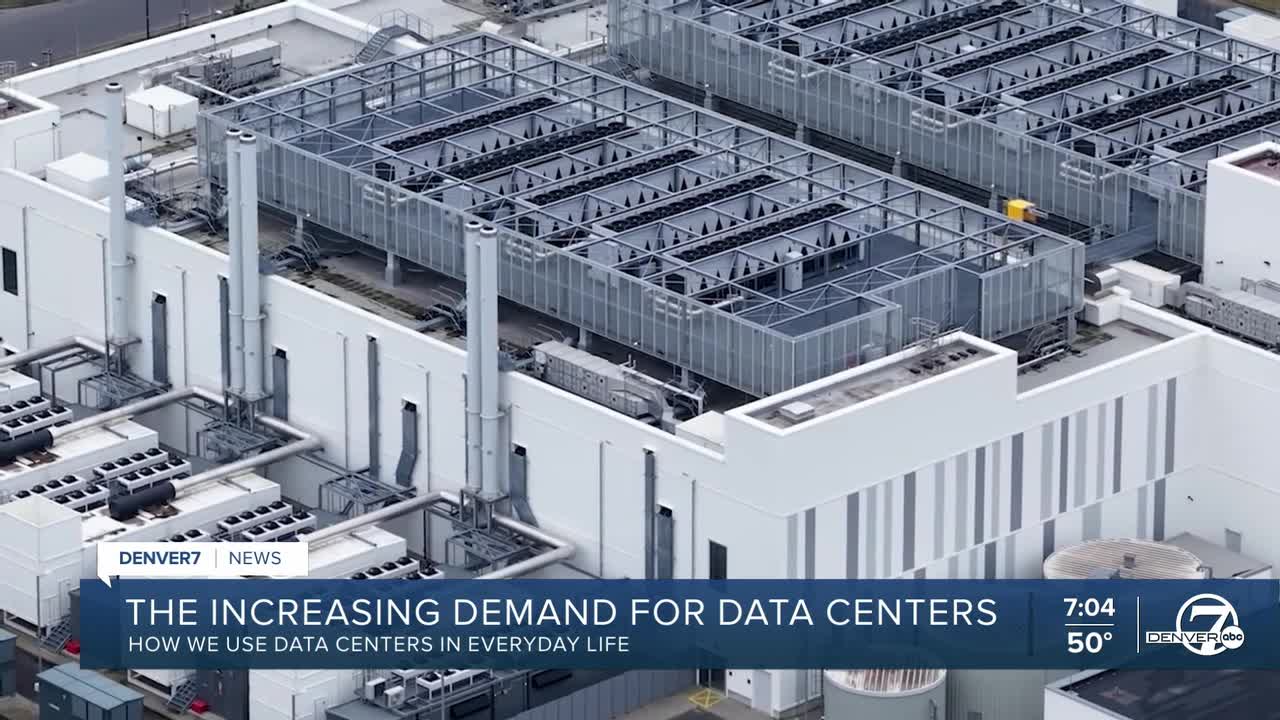


Think about how often you use your phone to search for something, ask Siri a question, or shop online. AI is increasingly built into those everyday tasks, and what you may not see is the massive infrastructure working behind the scenes to make it happen.
“When we're talking to our phones and interacting with many of the online applications, it's backed by AI. Even if you do a search, an AI assistant will pop up. Many of the shopping sites now have AI assistants on them, and so it's becoming more and more pervasive,” said MSU Denver computer science professor Steve Beaty.
See the full story in the video below
Those everyday interactions rely on powerful computers housed in data centers.
“Your phone essentially is connected via a cellular link, and that cellular link will then be connected to whomever is providing your information. When you interact with Siri, it's going to reach out to an Apple data center to get some of its intelligence,” Beaty said.

According to MSU Denver computer science professor Steve Beaty, the main reason why data centers are being built is because artificial intelligence takes a lot of power to train.
“Training is a big deal and interacting with them also takes energy. We have to put energy into these computers, and every watt of electricity, watt of heat, also needs to be brought out. That's the cooling issue,” Beaty said.
These computers produce a lot of heat so data centers need cooling systems, which can use large amounts of water. Beaty told Denver7 it’s cheaper to build larger data centers to begin with compared to smaller ones especially as demand is increasing.
“Bigger data centers will be less expensive on a per computer basis. On the other hand, it's going to take a lot of electricity and a lot of water to cool these things down. It's also going to be interesting as to whether we overbuild, and certainly there is a huge demand for data centers at the moment,” he added.
Beaty said communities also need to think about how data centers could affect the local power supply, create potential noise, and take up land, even as data centers can bring local economic benefits and construction jobs.
“There are pumps, transformers, all sorts of things that do cause noise. It's not necessarily loud, but it certainly is continuous,” Beaty said. “There always is going to be concerns about where the electricity is coming from. By and large, it's steam-driven turbines that have come from natural gas, and so the carbon footprint is an issue because the electricity has to be generated somewhere and somehow.”
Beaty told Denver7 the water usage among data centers is an issue.
“It's not if the water comes out polluted, but if it comes out drinkable, if you will. Some of those concerns are very valid and need to be considered carefully when we're talking about where a data center is built,” he added.
When it comes to land, Professor Beaty said when data centers are built it essentially is huge concrete buildings with parking lots.
“These sorts of things that might have originally been available to nature or for other uses, is now just going to be a big data center,” he told Denver7.
Beaty adds the more we use AI in everyday life, the more we’ll need additional data centers to fit that demand.




Denver7 is committed to making a difference in our community by standing up for what's right, listening, lending a helping hand and following through on promises. See that work in action, in the videos above.