

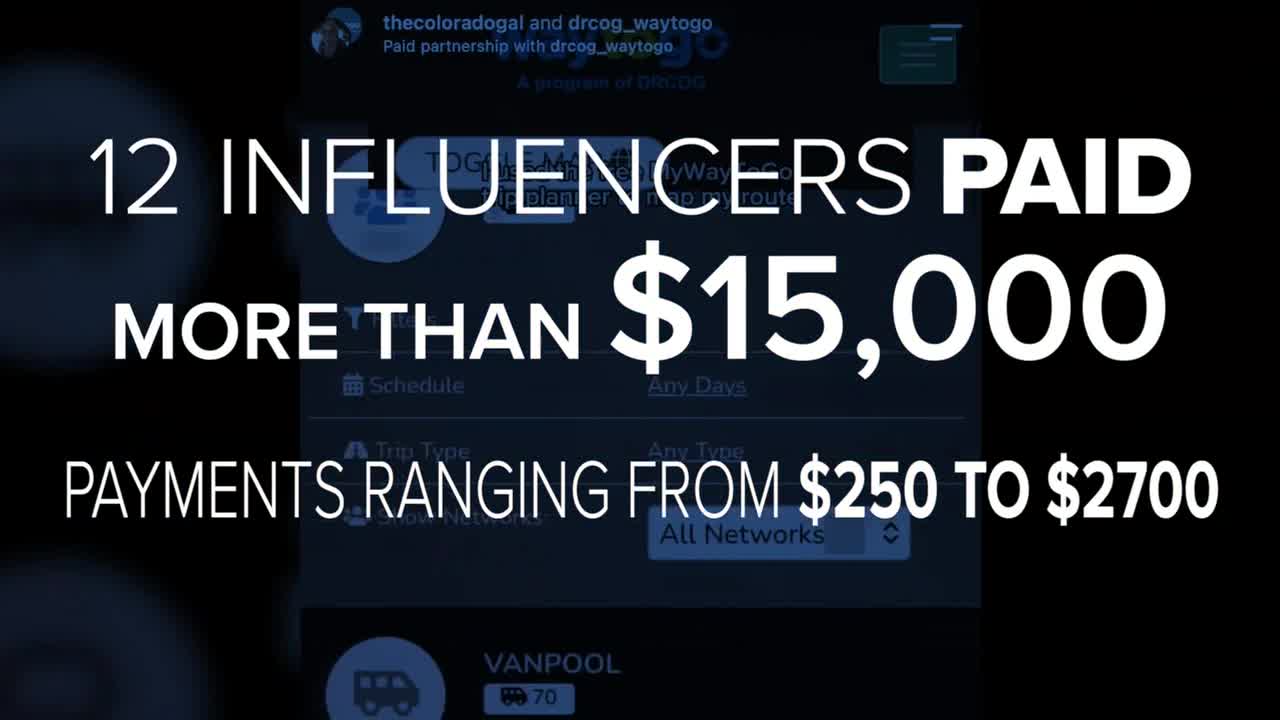


DENVER — Invoices obtained through an open records request show a Denver-area regional government agency paid a dozen local influencers a combined more than $15,000 over two campaigns this year to promote a bike-to-work initiative, and its "Way To Go" app.
A second agency, the Front Range Passenger Rail District, confirms it has its own budget that includes paying content creators.
It comes as more and more government agencies across the country turn to content creators to share messages.
What the DRCOG invoices show
The bulk of the spending — $12,000 — went toward a "Bike to Work Day" campaign in June and July, spread across 12 different influencers. Payments ranged from $250 to $2,300 per person, depending on the creator and the content delivered.
A second, smaller round of invoices — labeled "Way to Go Content" — shows DRCOG paid two of those same influencers again in August.
DRCOG says it's a new strategy
Nisha Mokshagundam manages DRCOG's Way to Go program, which promotes sustainable transportation options like biking, carpooling and transit to commuters across the region.
"Having influencers and partnering with content creators just helps us get our message out in a more broad way," Mokshagundam said. "I do want to share this is a relatively new tactic for Way to Go. We have just started partnering with influencers in advance of our June Bike to Work Day campaign. We're looking at the numbers. We're deciding if this is something that is sustainable that we want to continue doing."
Mokshagundam said the early results have been encouraging.
"I do want to share that our early metrics are really promising, and we are getting our message in front of new audiences," she said. "Of the visitors who come to our website through the influencer campaign, we have been able to find and track that 88% of them are brand new visitors and unfamiliar with our program."
Way to Go runs two campaigns that use paid influencers: Bike to Work Day and an ongoing brand awareness effort called Colorado Way to Go.
"I want to say anecdotally, I hear really great things about our influencer campaign," Mokshagundam said. "I was just at a conference the other week, and someone pulled me aside and said, 'Hey, I really love the new content that you're promoting.'"
The program's full budget is $900,000 a year, funded entirely through federal congestion mitigation and air quality dollars, according to Mokshagundam. Of that, she said DRCOG has invoiced about $20,000 to date for the influencer campaign specifically.
"Way to Go is supported entirely through federal congestion mitigation and air quality dollars," Mokshagundam said. "The money is for providing education, outreach, and marketing on these sustainable transportation options. We have a budget of $900,000 annually with a dedicated ad agency, and through this is how we've paid for our influencer campaign."
Mokshagundam said DRCOG does vet every influencer before signing on.
"We are a government program, so we definitely only want to contract with those people who can receive our funding without any issue," she said. "In terms of vetting, we took a look at their content. We do a discovery call with each influencer, and we talk about ways that we can both support their brand while also making sure that our goals are being met."
She said the agency looks specifically for creators rooted in the community.
"We want people with a local and regional focus," Mokshagundam said. "The one thing that most of our influencers have in common is their lifestyle influencers, whether their content focus is related to dining or enjoying the outdoors. We really want people too who are willing to try sustainable transportation and use new modes."
The rail district's much larger contract
The Front Range Passenger Rail District — the agency overseeing the proposed Colorado Connector rail line between Fort Collins and Pueblo — has its own content creator arrangement, built into a broader communications contract.
"During 2026, the Front Range Passenger Rail District contracted with Bagley Consulting LLC for approximately $260,000 to manage a broad digital communications program informing Front Range residents about proposed intercity passenger train service," said Tara Trujillo, spokeswoman for the district. "The contract covered website management, email and text updates, Friends of Front Range communications, CRM management, management of FRPRD's social media accounts, and coordination with 21 content creators. The content creators were one component of the broader yearlong contract."
Sal Pace, the district's general manager, said the digital outreach effort was one piece of a larger, legally required public engagement push.
"State law required us as a district to go and engage with the public, inform the public, and share information about CoCo and Colorado Connector," Pace said. "The district is almost from state line to state line, from Fort Collins to Trinidad — over 200 miles within the district — and it was just one of the tools in the toolbox to go and communicate with our constituents."
Pace said the district also held dozens of in-person events, but that reach had real limits.
"We actually held 32 town hall meetings, and over 3,000 people came to those town hall meetings," Pace said. "Via the digital program, cumulatively, we had over 300,000 people go to the delivery plan website."
He said six months ago, most people living in the district had never heard of the project.
"Six months ago, most people in the district didn't even know what Colorado Connector was or what the Front Range Passenger Rail District was," Pace said. "With the help of these social media partners, we helped reach lots of people over the last few months."
Pace said the legislature required the district to gather public input before voting on whether to refer a tax measure to the ballot.
"We received so many comments — hundreds of comments — and input from thousands of people," Pace said. "Overwhelmingly, the input that we've received has been positive, and it was part of what the General Assembly told us we had to reach out and get input from the citizens in the district before we could vote on a ballot referral. We took that statutory responsibility seriously, and we tried our best to reach as many people in the district as possible."
He defended the use of public money for the effort.
"We used funds that came from the legislature and from other sources," Pace said. "We're just following our statutory responsibility to do that outreach."
An influencer's perspective
Alana Boscoe, who has built her Colorado Gal platform over roughly five years, said she was approached by Way to Go about its commuter app and did her own vetting before agreeing to work with the program.
"My Way to Go had actually reached out to me about their commuter app," Boscoe said. "I thought it was just somewhat of a natural fit, because a lot of people in Colorado are looking for resources that they might not necessarily know about. I decided to do my own research and started using the app on my own."
Boscoe said she's since worked with the program on three videos — one tied to Bike to Work Day, and two others demonstrating how the app works.
"I've done three videos with them actually now," Boscoe said. "One of them was with Bike to Work Day, which I think is a great initiative that Colorado's been doing for several years. Then in addition to that, I worked with them on two other videos, just showing how the app truly works."
She said her audience comes first in deciding which brands to work with, regardless of pay.
"By no means do I think any of my reels are necessarily going to change the way someone commutes," Boscoe said. "But if it gets them talking, thinking, doing research, and then maybe taking that step to start using it, I think that's really what I'm here to do. There's nothing in a paid partnership that would ever skew me to choose that over my audience."
Boscoe, who said she also works a full-time job outside content creation, pointed to disclosure as the most important standard for creators taking paid work.
"I think the biggest thing as a content creator is really just being transparent with your community," Boscoe said. "Per FTC guidelines, if you are being paid, or you're even getting some sort of trade, you are supposed to put on the paid partnership label, and then your followers can see that you were paid for this, and then they can make their own decisions."
She said viewers should treat any influencer's content as a starting point, not a final word.
"I feel as though I am a source of information, but I am not a news source," Boscoe said. "I don't think that when you're making big decisions — like voting in elections — that content creators should be your one true north. Do your research."

Denver7 is committed to making a difference in our community by standing up for what's right, listening, lending a helping hand and following through on promises. See that work in action, in the videos above.