


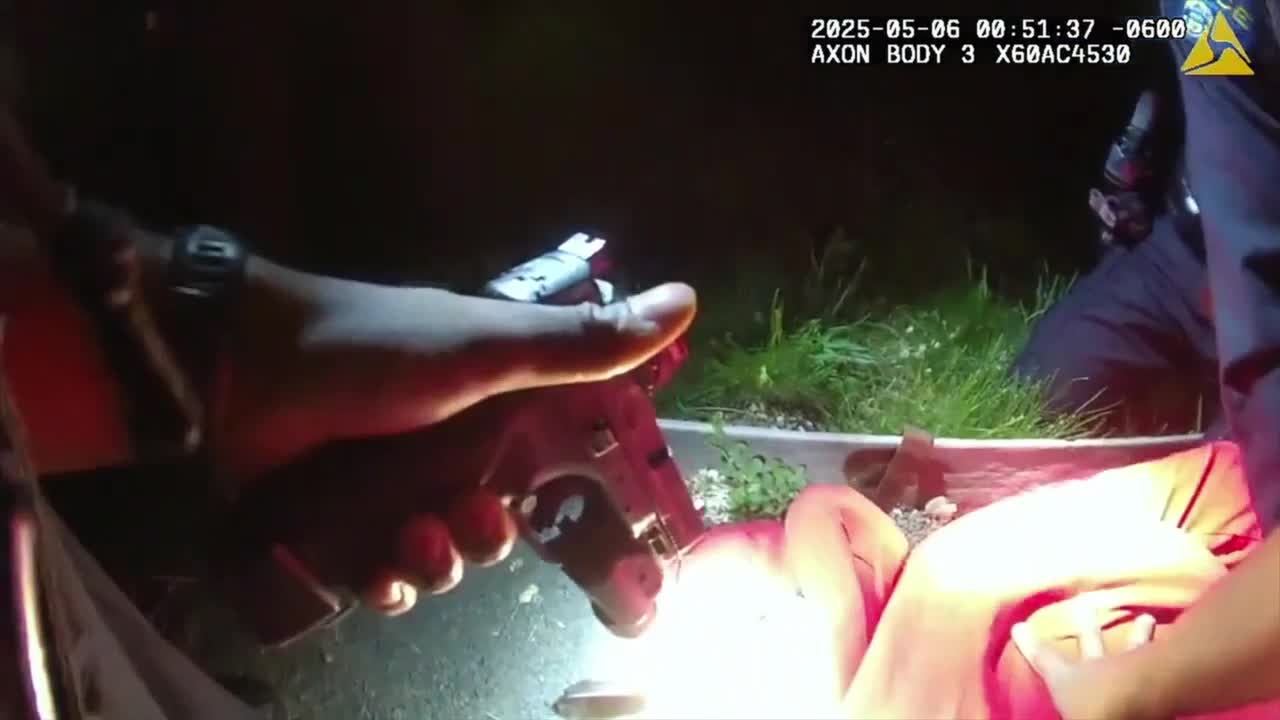


WHEAT RIDGE, Colo. — For roughly ten seconds, body-worn camera video shows a Wheat Ridge Police Officer holding a gun to a man's head who was already on the ground after a chase, and yelling "I'll put a bullet in your f---ing head" on May 6, 2025.
The officer was fired as a result.
The incident only came to light after investigative journalist Andrew Fraieli said he worked for months to obtain the body-worn camera video showing what happened. The fight for that footage exposed a tension between Colorado laws as well — one that protects the privacy of individuals involved in certain situations, and another that demands transparency from law enforcement agencies.
Denver7 obtained the records related to the investigation into the police officer and spoke with a defense attorney about how this incident highlights conflicting laws that may have otherwise been missed.
Fraieli is the executive director and founder of Blue Surveillance, a nonprofit organization based in Denver that promotes accountability for police misconduct through reporting, research, and public education. He closely tracks the Colorado Peace Officer Standards and Training (POST) website, which documents the certification of police officers within the state.
Fraieli told Denver7 he stumbled upon former Officer Carlos Bowdre's POST history, which shows Bowdre was terminated for cause in Aug. 2025 and voluntarily relinquished his certification in March of this year.
"I saw that, and so I do what I do with every officer that pops up. I went and requested his job application, his resume, all disciplinary reports, internal affairs investigations, all this stuff," Fraieli said. "One of the first documents that I got from Wheat Ridge was his disciplinary memorandum, which is basically saying why he got terminated.”
According to a statement released by the Chief of the Wheat Ridge Police Department (WRPD), Bowdre was fired in July of 2025 after a "thorough review" found Bowdre had "violated multiple critical department policies and core professional standards."

The document Fraieli initially obtained explained the incident that Bowdre responded to in May of 2025.
"They had a call about a man who had stolen a laptop, and the people whose laptop it was tracked it to this gas station. So the four officers, including Bowdre, go to the gas station and the guy runs," said Fraieli. “When he [Bowdre] got to the guy, the guy was already on the ground. His arms were already starting to go behind his back. He [Bowdre] put the gun flat up against the guy's head and said, 'I'll put a f---ing bullet in your head.'"
After reading through the description of the incident, Fraieli wanted to see what the body-worn camera footage showed as well.
"I requested the body cam footage. They said there were no responsive records, which doesn't make sense because by law they had to have still been retaining the record because — they're allowed to get rid of it after a certain amount of time, but we were still in that time frame," said Fraieli. “If they're denying it to me, they have to say why they're denying it. So I asked, 'Are you denying it, or do you not have it?' And they said they don't have responsive records.”
Such a response is indicative of a case that has been sealed, according to defense attorney Eric Faddis.
"A sealed case is a function of a judicial process whereby someone petitions the court to seal records in a case, and those records are largely inaccessible after that process is completed," Faddis explained to Denver7. "They [law enforcement] would be required by law to tell you that no public criminal records exist, and that's written into the record sealing statute. That's obligatory. They have to say that.”
Faddis said sealing a case is a relatively common request from defense attorneys, as it gives their client the opportunity for a fresh start.
“It allows them a greater chance at getting employment, housing, things like that," said Faddis. "I think there was really sort of a push not to have folks branded with a scarlet letter for the rest of their life in a way that substantially impairs their ability to function, to live.”
There are several reasons why a case may be sealed, Faddis said, but ultimately the court has significant discretion in deciding whether to seal records.
"Kind of a balancing test the court conducts, where it looks at, does the potential harm to the defendant's privacy, or the possibility of unwarranted consequences for that defendant, outweigh the public's interest in retaining that public access to those records," said Faddis. “That is the calculus in which the court engages when it's deciding whether or not to seal records.”
Fraieli said he realized the records related to the man who was chased in Wheat Ridge were sealed, but he still wanted to learn more about the investigation into the officer. According to Fraieli, he worked for almost three months to obtain the body-worn camera footage.
“It's important to be able to see that this happened and have that emotional impact," said Fraieli. "For all the times that we find this one video of this one instance, there are surely many more that there's just no reason to know that it happened.”
After the footage was released to Fraieli, Denver7 was able to obtain the video and the corresponding 280-page report that details the investigation into Bowdre.

That report shows WRPD launched an investigation into Bowdre's actions in May of last year, and he was placed on leave before ultimately being fired. The documents detail what training Bowdre received, with one academy coordinator claiming they knew "for certain that Officer Bowdre was never taught to place a gun to a subject's head during an arrest."
The WRPD Police Chief, Chris Murtha, reviewed the investigation and determined that Bowdre's conduct was "unacceptable." In addition, Murtha noted that the district attorney's office did not move forward with the case "in large part" due to Bowdre's actions.
Within the report provided to Denver7, Bowdre responded to the notice of proposed disciplinary action via an attorney, who said Bowdre denies that his intention behind his conduct was "malicious, disrespectful, or inhumane." Instead, Bowdre's attorney said his actions were "motivated by a legitimate concern for officer safety."
Bowdre's attorney noted that he took "responsibility for his shortcomings" and "participated candidly throughout the process." In addition, the attorney wrote that Bowdre had no prior disciplinary history with WRPD or any department, "given his lack of experience as a sworn peace officer."
Chief Murtha provided an extensive statement to Denver7 when asked about Bowdre's investigation, beginning by saying the "conduct depicted in that video is deeply concerning and falls well below the standards, expectations, and values that define the Wheat Ridge Police Department."
► Watch Colette Bordelon's report in the video below:
Murtha continued to address questions raised regarding the department's communication with the public and release of information related to Bowdre.
"Colorado law requires law enforcement agencies to release internal affairs records, subject to required statutory exceptions. At the same time, other state laws require agencies to protect the legal rights and privacy interests of individuals involved in certain circumstances," Murtha wrote. "Our legal counsel carefully reviewed the applicable laws, researched relevant legal precedent, and consulted available resources to determine the most appropriate course of action. After careful deliberation, we adopted an approach that sought to honor both the letter and the spirit of the law by releasing appropriately redacted records that advanced transparency while protecting the legal rights of those involved."
Near the end of Murtha's statement, he said the "termination of the officer reflects our commitment to accountability." In contrast, the department's "efforts to comply with two conflicting legal requirements reflect our commitment to fairness, the rule of law, and the protection of individual rights."
Faddis said he can understand how a law enforcement agency could be caught in the middle of the statutes that demand transparency while also requiring privacy, saying there appears to be a conflict between the two.
“On the one hand, the record sealing laws require law enforcement to say no public criminal records exist with respect to this case. On the other hand, the Enhance Law Enforcement Integrity Act requires disclosure of some of those very same materials, including body camera evidence," said Faddis.
At the same time, Faddis could see how some law enforcement agencies could use the record sealing laws to conceal police misconduct.
“When these record sealing laws were enacted, there wasn't maybe such a sense of ongoing police misconduct, and we sort of assumed the cops were all the good guys, and unfortunately that's not always reality," Faddis said. “How many cases have been sealed that may have involved allegations of police misconduct, and does that mean that those allegations, those incidents, are just lost to time forever? You know, shouldn't we be able to track these things and learn from mistakes and develop lessons from these events?”
Faddis believes state lawmakers should revisit the record sealing laws in light of this development out of Wheat Ridge.
“Going forward, it might make sense for the General Assembly to try to clarify what law enforcement entities should do when they are faced with such a request under these circumstances, because you know it's probably not appropriate for law enforcement to use a law designed to protect the accused for their own purposes for their own protection to shield information from the public, and so perhaps that piece of the record sealing laws need to be clarified by the General Assembly," said Faddis.
Read the full statement from WRPD Police Chief Chris Murtha below:
To Our Community and Members of the Media,
The Wheat Ridge Police Department is aware of the public release of a video and the related investigation involving a former officer of our agency. The conduct depicted in that video is deeply concerning and falls well below the standards, expectations, and values that define the Wheat Ridge Police Department.
After supervisors and officers on scene reported concerns regarding the officer's actions, the department initiated an administrative investigation and placed the officer on suspension pending its outcome. Upon completion of a thorough review, the investigation determined that the officer had violated multiple critical department policies and core professional standards. As a result, the officer's employment with the Wheat Ridge Police Department was terminated.
Accountability and transparency are fundamental to earning and maintaining the public's trust. They are principles that guide our decisions and have long been central to our relationship-based policing philosophy. While some who are unfamiliar with our department may judge our organization based solely on this incident, it is important to recognize that our accountability systems functioned as intended. When an employee fails to meet the professional standards expected of every member of this department, appropriate action is taken. In this case, that action resulted in termination.
Questions have understandably been raised regarding the department's communication with the public and the release of information. We believe those questions deserve a clear explanation.
Colorado law requires law enforcement agencies to release internal affairs records, subject to required statutory exceptions. At the same time, other state laws require agencies to protect the legal rights and privacy interests of individuals involved in certain circumstances.
Our legal counsel carefully reviewed the applicable laws, researched relevant legal precedent, and consulted available resources to determine the most appropriate course of action. After careful deliberation, we adopted an approach that sought to honor both the letter and the spirit of the law by releasing appropriately redacted records that advanced transparency while protecting the legal rights of those involved.
We recognize that our community expects openness from its police department, and rightly so. We believe this approach reflects a thoughtful balance between our obligation to provide transparency and our equally important responsibility to respect the legal protections afforded to individuals under Colorado law.
No use of force is easy to witness, and the conduct in this incident did not reflect the professionalism expected of a Wheat Ridge police officer. The department addressed that failure decisively, demonstrating our commitment to holding our employees accountable without hesitation or external pressure.
This has been a difficult case, and we understand why members of our community continue to ask about transparency. Our commitment has never been to conceal misconduct or shield those who violate the public's trust. Rather, our commitment is to be transparent whenever the law allows, to act decisively when our standards are violated, and to carefully navigate situations where legal obligations require us to balance competing interests.
The termination of the officer reflects our commitment to accountability. Our efforts to comply with two conflicting legal requirements reflect our commitment to fairness, the rule of law, and the protection of individual rights. We believe both responsibilities are essential to preserving the public's confidence in the Wheat Ridge Police Department.
We remain committed to serving our community with professionalism, integrity, transparency, and accountability. Those values will continue to guide our actions and our decisions every day.
Sincerely,
Chief Chris Murtha
