

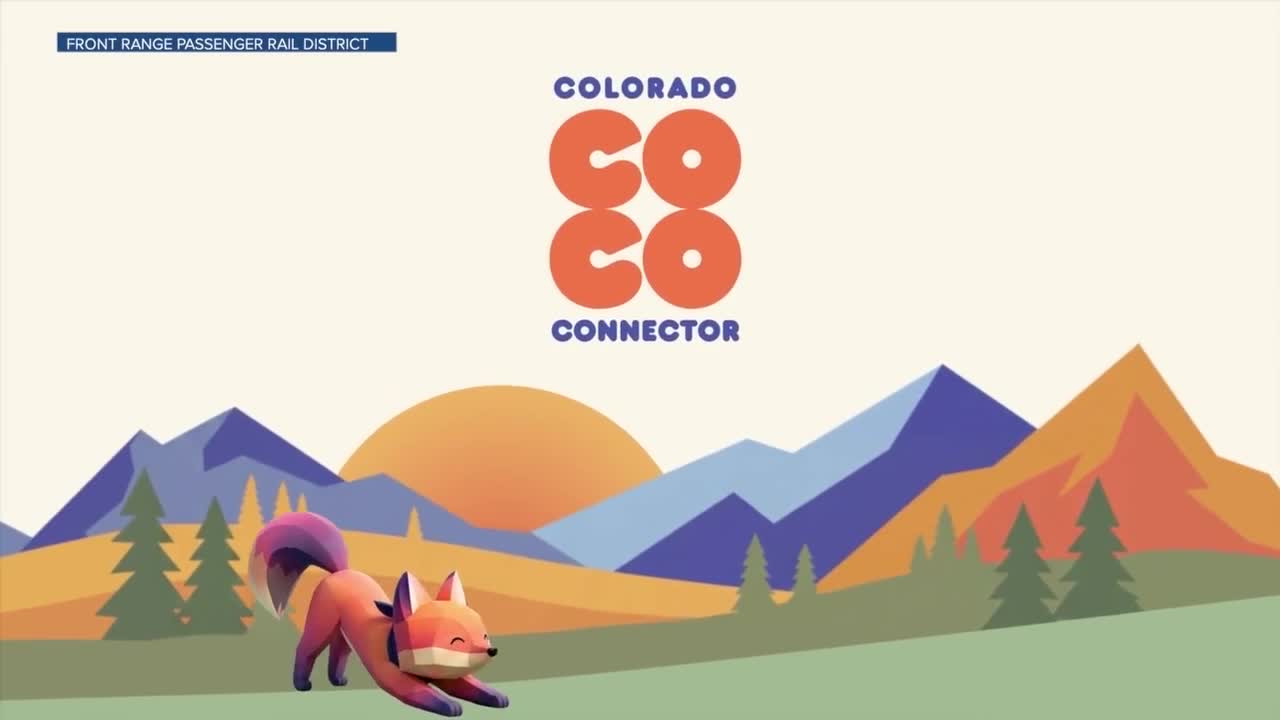


DENVER — The proposed Front Range passenger rail service is getting closer to reality after the district unveiled its new look, name and logo on Sunday.
Colorado Connector, or CoCo, will be the name you will see on the side of rail cars and engines when the first phase of the project is expected to begin service in about three years.
When fully completed, CoCo rail service will connect 12 communities from Pueblo to Fort Collins using existing freight rail lines.

The first phase of the service, expected to open in 2029, will operate three daily lines from Denver to Fort Collins.
Full service spanning the entire Front Range, including Colorado Springs and Pueblo, is planned to be up and running sometime in 2032, if voters approve a sales tax increase.

According to the Front Range Passenger Rail website, a trip from Fort Collins to Denver will take approximately one hour and 30 minutes, and two hours and 30 minutes from Denver to Pueblo.
Initial service will be operated by Amtrak, bringing expertise in crews, ticketing, maintenance and federal safety compliance to the platform.
Funding for the service is through a combination of federal grants, state funding, local revenue, and potentially a voter-approved sales tax.
However, unanswered questions remain concerning the total cost of the project.
The Front Range Passenger Rail District website estimates the cost at between $3 billion and $3.5 billion, but Front Range Passenger Rail District General Manager Sal Pace would not provide an exact figure when he spoke to Denver7 earlier this year.
“We need to figure out exactly what we can afford, and then how many phases we can afford and what we want to fit in. As we figure out the financial piece, we're going to figure out exactly how far (and) how many phases,” Pace said.


Denver7 is committed to making a difference in our community by standing up for what's right, listening, lending a helping hand and following through on promises. See that work in action, in the videos above.
