


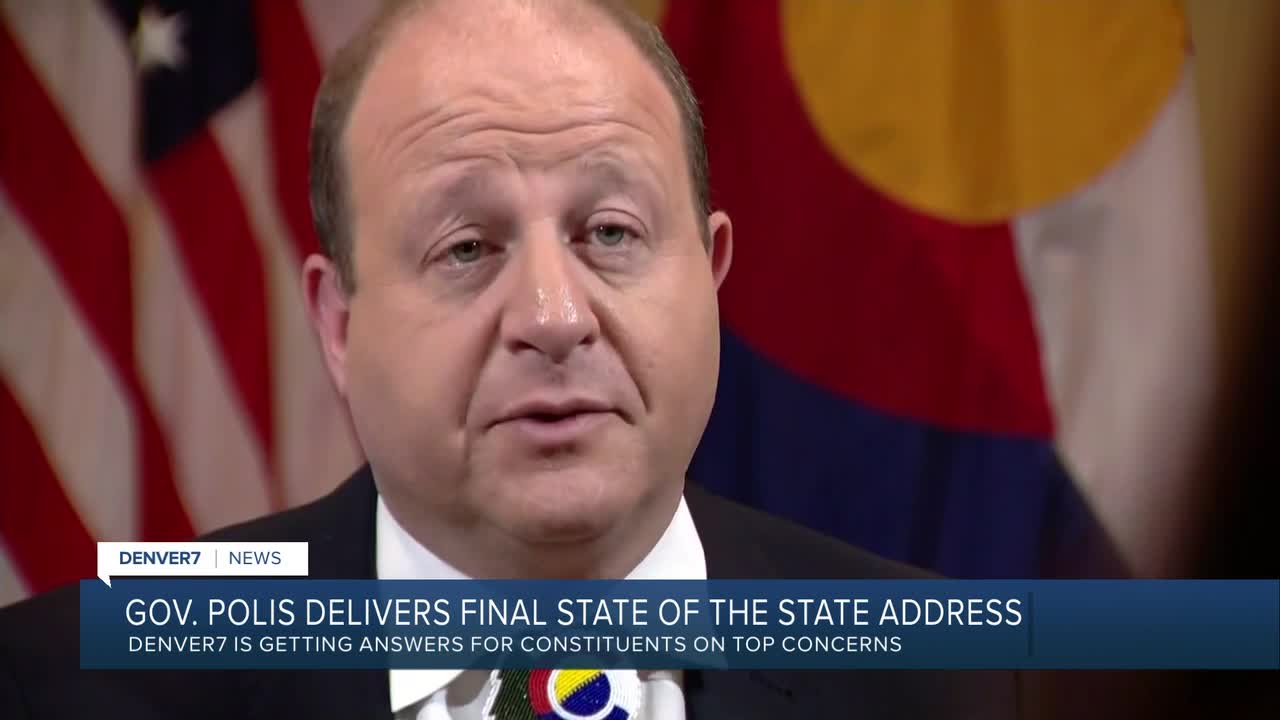


DENVER — Moments after Governor Jared Polis delivered his last State of the State address, Denver7 was given seven minutes to discuss everything from the roughly $850 million dollar budget deficit facing the state legislature, to the federal attacks aimed at Colorado from the Trump administration, and Polis' comments about the former Mesa County Clerk convicted of state crimes for orchestrating a breach of the county's elections equipment.
- You can watch the full interview with Denver7's Colette Bordelon in the video player below.
The full interview is transcribed below, and has been edited for clarity.
Q: What will your legacy be for Colorado and what's next for you?
A: Well, a big part of the work I've done, you know, when I ran for Governor of Colorado, we had half-day kindergarten. Parents had to pay for full-day preschool. You had to pay for it. We have free preschool and kindergarten for every kid. Huge progress on cleaner air. More ways to get where you want to go. We have the bus ridership increased five times for people who want it. We've also put a lot of money into successful road projects. We're working on Floyd Hill now, we started that. Additional funding for roads and bridges. And of course, focus on making sure that everybody of all ages can get better training to help get better jobs. And we continue that work.
Q: You recently called Tina Peters sentence harsh. Are you considering commuting or pardoning Tina Peters? And do you feel pressure from the federal government to do so?
A: We look at every case individually, and this is somebody who's a first-time offender, nonviolent offense. Very unusual in our state that they would get that kind of punishment. So, it's something that we look at, along with many other hundreds of people who've applied for clemency.
Q: How can the state of Colorado protect itself from federal funding cuts? And do lawsuits simply buy us more time?
A: Well, when federal funding cuts are illegal, the courts have sided with us. We've been able to restore some of those funding streams. Some of them could work their way up all the way to the Supreme Court, but there's other funding cuts that were elective and might even be legal, so it just depends on the cut. But we're currently in over 50 lawsuits with the federal government, working with Attorney General Weiser.
Q: You're recommending that the JBC privatize Pinnacol Assurance, something they rejected last year. Why do you think that could be successful this year? And what would be the consequences if they do not?
A: As legislators learn about it, I mean, the consequences are, it dwindles every year, and their business model no longer works. It'll be bad for workers, bad for businesses without some kind of conversion or change in the next few years. And it's better to do it sooner rather than later, to make sure that we can continue to provide insurer of last resort to workers across our state.
Q: I'm told there's going to be a push from lawmakers to try to reexamine TABOR this year in order to better fund K through 12 education. Would you support such a change?
A: I don't know what they're proposing yet. We’re happy to look at any bills that come our way.
Q: I know you've talked at length about this, but Medicaid is the fastest growing part of Colorado's budget. I've spoken with advocates who believe we should still be looking elsewhere to make cuts. Why do you believe Medicaid is where we need to cut? And how do we do so responsibly?
A: What we need to focus on, as I mentioned in my speech, is results. Better health outcomes. And we've spent more without getting better health outcomes. That's just bad business. You know, we want to make sure that we align access to health care with good outcomes for patients, and we need to do a better job doing that on Medicaid as well as in the private insurer space.
Q: You've been vocal about a pro-freedom stance when it comes to vaccine mandates. Critics might say, though, that that could be dangerous for families who then decide not to vaccinate their children. Why has that been something you've been so vocal about?
A: It’s not something I talk about other than when people try to impose mandates, I say, 'No, it should be up to people's choice.' I mean, this is your body, your choice. I mean, whether that's an abortion, whether it's a vaccine, whether it's health care you're getting. I mean, the government shouldn't force you to do certain treatments if you don't want it. I mean, I encourage everybody to get vaccinated. It's a great way to protect yourself from disease. Our families fully vaxxed, and I hope more people do it.
Q: Last year, you vetoed more bills than ever before. There's a similar bill that will be worked on this year letting workers unionize in a more simple fashion here in Colorado, that was one you vetoed last year. If that measure makes it back to your desk, what would you do with it?
A: Well, I haven't changed my mind on anything. And, you know, obviously have the same positions I had before. And there, you know, as you said, in every given year, there's, you know, anywhere from five to 15 or so bills that are vetoed. It just depends on whether legislators make the changes we need, or whether they send it to my desk. In a way, I just weigh whether it's good for Colorado. And a number of times, there's bills from Republicans or Democrats that I think didn't make that mark.”
Q: The rideshare bill, another bill that was vetoed along with the social media regulations bill, critics have said it's because you're pro-big tech. What is your response to that?
A: In all of those veto letters, we usually spell out what my objections to their bill are, and there's been many times in past sessions where bills that I vetoed would then be revised to what we say would be acceptable and come back. So, just depends on what legislators want to do. And I encourage those conversations.
Q: Can you or your office do anything to speed up assistance for Colorado drivers who were impacted by the diesel mix up?
A: Yeah, obviously, that's being investigated, rightly so. I mean, this is a terrible mix up that's causing a lot of difficulty for people that are affected, and we want to do everything we can to assist those who are affected.
Q: The wolf reintroduction in Colorado can be described as difficult, I think, and, you know, maybe other words as well. What grade would you give to our wolf reintroduction so far?
A: This is something the voters gave us to do. There's a number of big initiatives over the year. FAMLI Act being another one. I think the folks at Colorado Parks and Wildlife handle them as best they could. I mean, I think they're great professionals. They care deeply about our wildlife, our hunters, our ranchers, our community, and they're certainly doing the best they can with it.
Q: Republicans still saying that the budget deficit we find ourselves in is caused by Democrats mismanaging the state over the last eight years, and not directly tied to H.R.1. I know nonpartisan legislative staff has said otherwise, but what is your response to that?
A: That's just simple math. I mean, without H.R.1, we'd have a surplus of several hundred million dollars. With H.R.1, because the state concurrently adopts its taxes in the current year, it goes to a deficit of a couple hundred million. So, it's just mathematics. There's really no way to deny that, objectively, had H.R.1 not become law, the state would have a surplus and a TABOR refund.
Q: And I just want to circle back to one more thing, since I'm through with my list, so you are considering commuting or pardoning Tina Peters sentence?
A: Well, yeah, we look at every application that comes in. I mean, there's hundreds of people who have applied for clemency. I look at things like sentences that are too long. We look at things like how well people have behaved behind bars. Every year I've done some and I've told folks in my final year, of course, like many governors, I do intend to really lean into that value of mercy and see what I can do to help give people a second chance.
Q: Has her attorney contacted you at all? Have you guys been in discussions?
A: There's a formal application process for clemency, and she's one of many people that have applied for that that we’re reviewing.
