

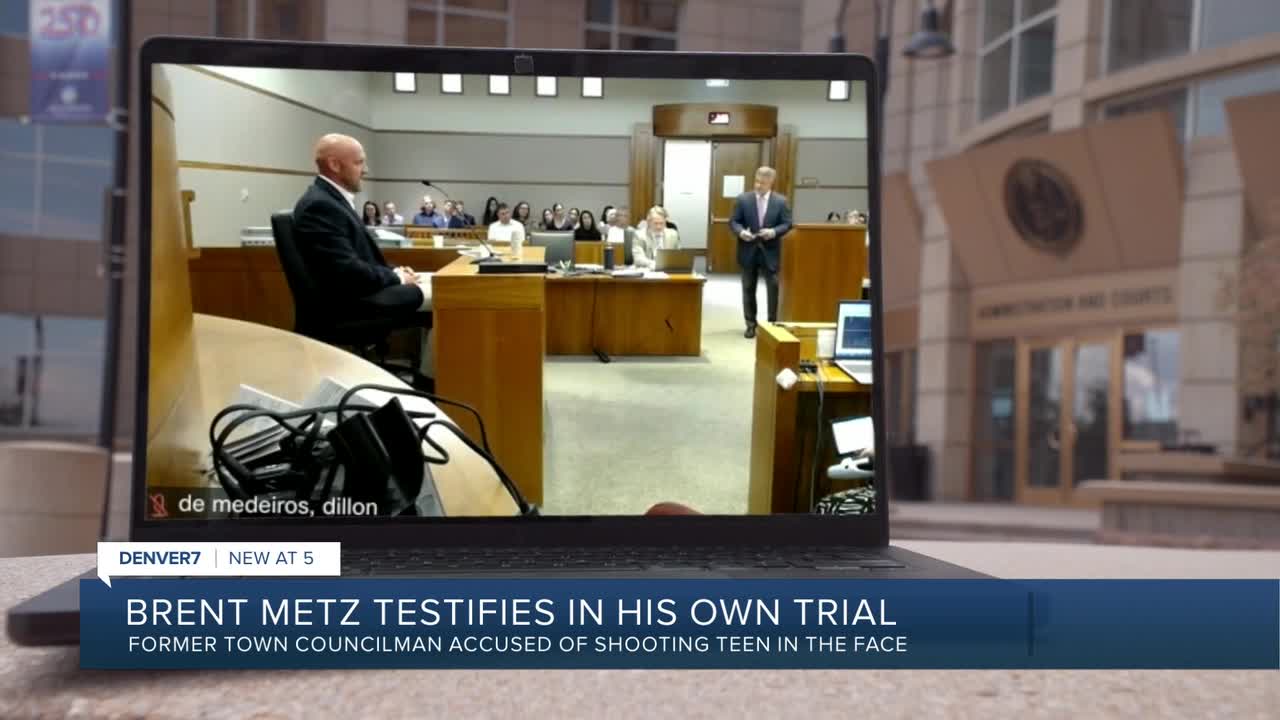


JEFFERSON COUNTY, Colo. — The defense rested their case on Friday afternoon in the trial of a former Mountain View Town Council member, who told the jury he never pulled the trigger when his gun fired, shooting a teen in the face.
On Sept. 10, 2024, the Jefferson County Sheriff's Office (JCSO) reported that two teens — then 17-year-old Jack Howard and 15-year-old Luke Brookhouser — walked through Brent Metz's property without permission. The boys said they hopped the fence, hoping to speak with the homeowners about using the land for homecoming pictures.
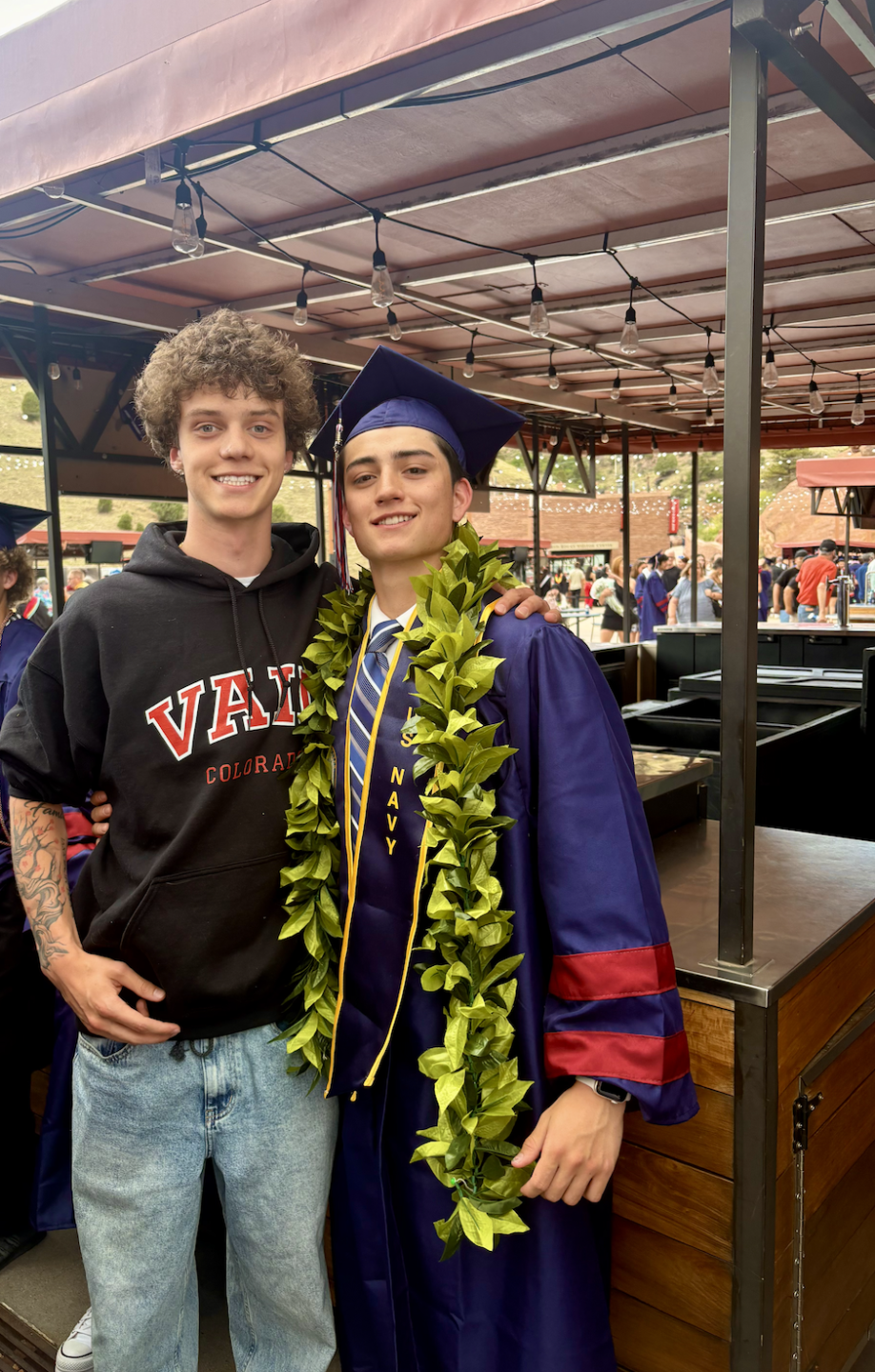
Upon realizing no one was home, the boys walked back to their car, where they began to write a note while parked on the side of the road. The defendant, Metz, said he pulled up alongside the boys in their car and intended to speak with them — but asserted that when he exited his truck, he lost his balance "and the firearm discharged."
Metz faces four felony charges: second-degree assault (recklessly causing a serious bodily injury with a deadly weapon), two counts of felony menacing and illegal discharge of a firearm.
He pleaded not guilty to all charges in April 2025 and was removed from Mountain View Town Council during a special election in May 2025.

After opening statements of the trial Wednesday, prosecutors worked to prove to the jury beyond a reasonable doubt that Metz was reckless on that day in 2024, while his defense team tried to cast doubt upon the way the teen boys remember the shooting and argued that the make and model of the gun in question is notorious for malfunctioning.
Howard, the teen who was shot in the face, testified on Thursday and told the jury he believed he would die from his injuries that day.
On Friday, Metz's defense team concluded their argument after Metz took the witness stand and told his side of the story.

The first witness called to the stand on Friday was Chris Loots, who has known Metz since college. Loots testified that the two shared commonalities, like growing up in small, rural towns, and began hunting together.
“Brent, with his ROTC background as well, is very well-trained with firearms," Loots said. “Very scrutinous about safety.”
After college, the two would hunt more regularly. Loots told the jury he has observed Metz teach others how to handle firearms safely.
“He’s one of the safest people that I’ve shot firearms with," Loots said on the stand. “I would trust Mr. Metz with my life."
Next, the defense called their expert witness in firearms, firearm safety, and firearm components to the stand. Edward Wilks said he has owned a gun store in Rifle for roughly 25 years, and teaches concealed carry handgun classes along with firearm safety. Wilks also has a background in law enforcement.
Wilks examined the gun in this case, which was a SIG Sauer P320. According to Wilks, there are many ways that kind of gun can fire without the trigger being pulled.
“It has been my observation that that happens all the time," Wilks said about unintentional firings with the SIG Sauer P320. “It is not safe. It shouldn’t be owned.”
According to Wilks, he will not even stock the SIG Sauer P320 in his store.
“I saw that as a train wreck waiting to happen, but then, my observations were all, unfortunately and sadly, they were all verified," Wilks testified.
According to SIG Sauer, "the P320 cannot, under any circumstances, discharge without a trigger pull."
However, Wilks claimed he was able to make Metz's SIG Sauer P320 fire without pulling the trigger, and only by touching the trigger slightly on the side.
In addition, Wilks said the spent casing found in the chamber of Metz's gun tells him the weapon was being held loosely.
On Thursday, the prosecution's expert witness in firearms design and manufacturing, Derek Watkins, told the jury he ran a number of tests on the specific SIG Sauer P320 that was owned by Metz. According to Watkins, his analysis revealed — via the physical testing of the gun — that it would not have fired unless a trigger was pulled.
Then, Eugenio Liscio took the witness stand and walked the jury through a three dimensional rendering of the scene, demonstrating the trajectory of the bullet. According to Liscio's analysis, the weapon would have been fired as Metz was exiting his truck.
Metz took the stand in his own defense on Friday afternoon, telling the jury he is a general contractor, and in the past was a mechanical engineer who worked in the oil and gas industry.
While attending college, Metz said he was in the U.S. Air Force. He was first introduced to firearms as a Boy Scout, becoming an avid hunter as he grew older. According to Metz, he has been a concealed carry permit holder for approximately 20 years.
On the stand, Metz was asked about prior testimony from a JCSO investigator who said he does not own the property in Conifer. Metz disputed that, saying he does indeed own the Conifer property where the two teenagers wanted to take homecoming pictures.
Metz testified that he does not concealed carry at schools, churches, or public events — anywhere that is prohibited by law.
Whenever Metz does have his handgun, he said it is holstered on his hip. The firearm is transferred to a holster in his truck when he drives.
Before Sept. 10, 2024, Metz testified that he had never experienced an accidental, uncommanded discharge of a firearm.
"The day started off like a normal day," Metz told the jury about the day of the shooting.
According to Metz, he took his girlfriend's children to school in the morning, visited one of his construction sites during the day, and was preparing for a hunting trip.
His girlfriend called, telling Metz about a car in their driveway and individuals by the barn on the property. Metz said at that point in time, his girlfriend had been a victim of a handful of crimes against her, so he tried to calm her down and told her to call the police.
Meanwhile, Metz said he briefly checked the cameras on the property and saw the teenage boys. He told the jury he was fairly confident there was "no nefarious activity" occurring.
Metz said he would not describe himself as angry as he drove to the home. Instead, he said he was concerned since he did not recognize the people on the property. He added that there are often neighbors who stop by the land to take pictures or access the pond.
When Metz arrived, he said he was surprised the car was not in the driveway, where he expected it to be. Instead, the boys had moved their car out of the driveway and to the side of the road.
In Metz's retelling of the day, he said he did not "come in hot" when he parked next to the boys in their car. His intention, according to Metz, was to have a conversation with whoever was at his home.
Metz told the jury that when the shooting occurred, he was not drawing his weapon to fire, but instead was attempting to switch it from his vehicle holster to his hip holster as he got out of his truck.
“I remember, very clearly, every detail of the situation," said Metz. “It’s the same movement I have conducted thousands and thousands of times before."
However, Metz claimed the ground was not where he expected it to be and lost his balance, then felt the gun discharge against his belly without commanding it to do so. He told the jury he never placed his finger on the trigger.
“It was extremely fast," Metz said.
Metz said he attempted to render aid to Howard because "I realized what had happened, and it’s the last thing I would ever want to happen to anyone, and that’s my instinct is to help."
Prior to the shooting, Metz claimed he had no knowledge of the controversy surrounding the SIG Sauer P320, and said he would not have purchased that gun if he would have known about the unintentional firing claims.
"I feel horrible this happened to these two young men — it’s something I will struggle with for the rest of my life," Metz said on the stand.
On cross-examination, Metz told the prosecutor he understood he is not being charged with an intentional act. Prosecutors must prove he was acting recklessly.
Metz could not recall if he apologized to the teenagers at the scene.
"I wish I could absorb that pain for them. I have wrestled with this every minute for the last year and a half," said Metz.
According to Metz, he would have allowed the boys to take homecoming pictures at his property.
The trial will resume on Monday morning, with jury instructions at 9 a.m. After that, both sides will present their closing arguments before the case is handed over to the jury to begin their deliberations.


