

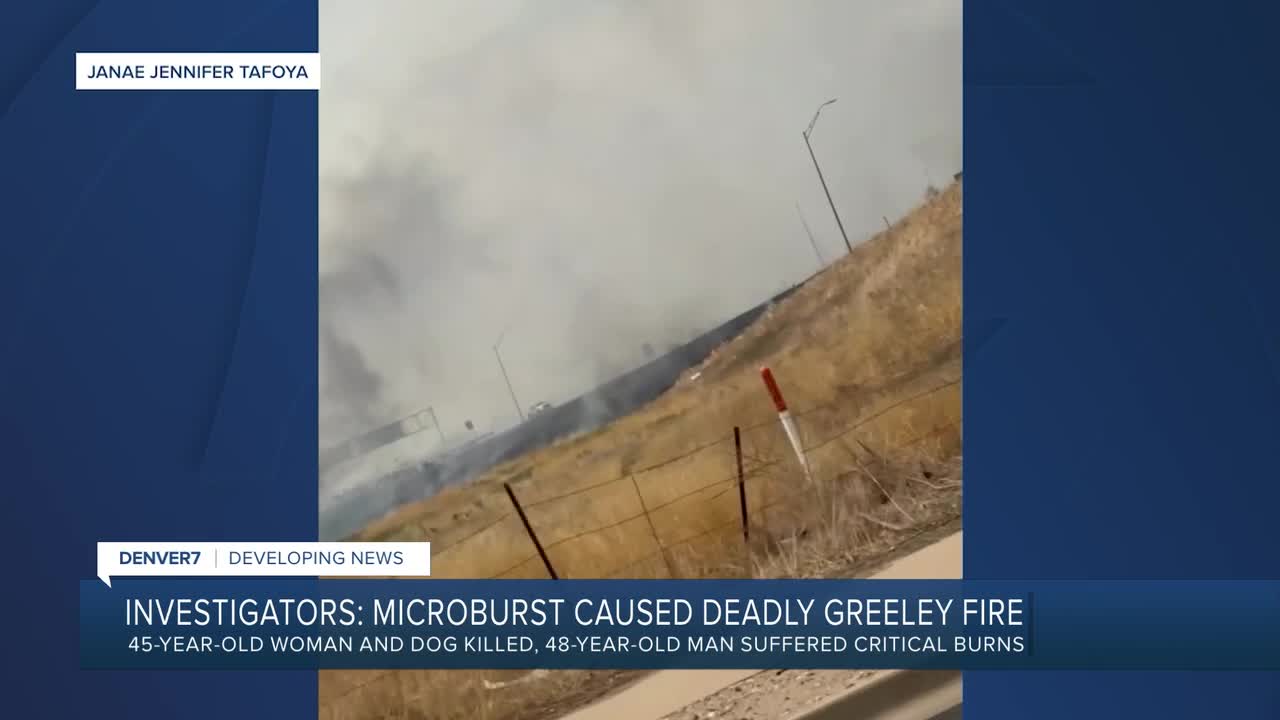


GREELEY, Colo. — The Greeley Fire Department has determined that Sunday’s fatal vegetation fire was accidental and caused by an electrical failure during a powerful dry microburst.
The fire near the interchange of U.S. 34 and U.S. 85 killed 45-year-old Dizarae O'Toole-Ochoa and critically injured her 48-year-old male partner.
Watch the latest on this story in the video below:
The investigation determined that wind gusts of 85 to 100 mph damaged transmission-support structures beneath a high-voltage power line corridor.
As a result, an energized conductor failed at a compression connector, releasing electrical energy that ignited vegetation below.
The fire then spread rapidly across about 22 acres due to the strong winds, extending into a nearby homeless encampment, where O'Toole-Ochoa was killed, and the 48-year-old man suffered critical burn injuries, the fire department said.
The man's current condition is not known. Investigators said a dog was also killed in the fire.
Following the tragedy, Tammy McKee, the mother of the victim, told Denver7 that her daughter had recently moved to the homeless encampment with her partner when the fire tore through the area.
The loss has led McKee to call for additional resources for people experiencing homelessness in Greeley.
"I just want resources here so these people can get off the streets before somebody else dies," McKee said.
The investigation further concluded that there was no evidence the blaze started in the encampment or was intentionally set.
They said physical and electrical evidence, witness statements, video footage, emergency communications records, and National Weather Service analysis support their conclusion.
According to the NWS, a microburst is a powerful, localized downdraft capable of producing damaging winds over a relatively small area.
It forms when a thunderstorm's updraft can no longer support large amounts of rain and hail suspended high in the storm, creating a powerful downdraft that spreads outward in all directions when it hits the surface.
The location in which the microburst first hits the ground experiences the highest winds and greatest damage, according to the NWS.


Denver7 is committed to making a difference in our community by standing up for what's right, listening, lending a helping hand and following through on promises. See that work in action, in the videos above.


