

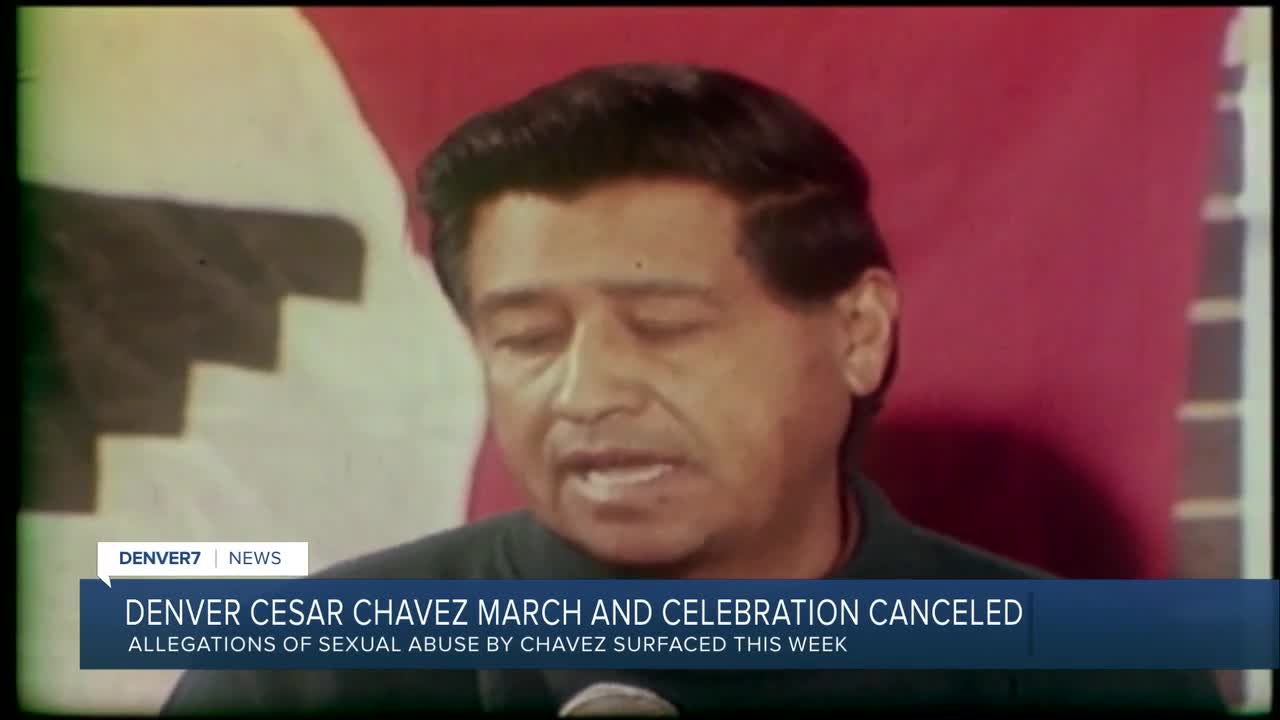


DENVER — Denver's Cesar Chavez Day March and Celebration, scheduled for April 11, has been canceled amid allegations that the iconic labor and civil rights leader sexually abused young girls while he led the United Farm Workers union in the 70s.
"The César Chávez Peace and Justice Committee of Denver has reviewed the allegations against César Chávez," the group wrote in a Facebook post announcing the cancellation. "The Committee unequivocally supports the abused women and children and their survivors."
The Cesar Chavez Peace and Justice Committee of Denver said it plans to hold a future event celebrating local unions and immigrant rights organizations that participated in past marches.
"The Committee continues to support their struggle towards liberation and social justice for all people," the statement said.
The city's annual proclamation commemorating Chavez, scheduled for Monday, has also been canceled, a spokesperson for council member Jamie Torres said. She said there are "currently no plans yet on any of the places and spaces named for Cesar Chavez."
"This news is so fresh and heartbreaking, I think community is still coming to terms and opening up the channels for survivors and victims to continue to come forward," she wrote in the statement.
Cesar Chavez Day is a federal commemorative holiday, and its observance is written into Denver city policy. A spokesperson for the mayor's office said this year's end of March holiday will continue to be observed by city staff, but that no celebrations are planned by the mayor's office.
"We are appalled by the allegations against Cesar Chavez and our thoughts are with the survivors. The city is currently collecting information and evaluating steps going forward," Jon Ewing, a spokesperson for Mayor Mike Johnston's office, said in a statement.
On Wednesday, an investigation by the New York Times found that Chavez groomed and sexually abused young girls who worked in the movement, including fellow labor rights activist Dolores Huerta, who was in her 30s at the time. In 1962, Chavez and Huerta co-founded the National Farm Workers Association, which became the United Farm Workers of America.
The allegations against Chavez, who died more than three decades ago, drew immediate calls to change events and memorials honoring the man who in the 1960s brought to light the struggles of field workers.
In a statement released Wednesday, Huerta said she stayed silent for 60 years out of concern that her words would hurt the farmworker movement.
Huerta described two sexual encounters with Chavez, one where she was “manipulated and pressured” and another where she was “forced against my will.”
“I carried this secret for as long as I did because building the movement and securing farmworker rights was life’s work. The formation of a union was the only vehicle to accomplish and secure those rights and I wasn’t going to let Cesar or anyone else get in the way.”
The United Farm Workers union has also distanced itself from annual celebrations of its founder, Chavez, amid what it said were troubling but unspecified allegations.
In a statement Tuesday, the union said allegations of "abuse of young women or minors" were concerning enough to urge people around the country to participate in immigration justice events or acts of service instead of the typical events in March to commemorate Chavez's legacy.
Several Cesar Chavez celebrations in San Francisco, Texas and Chavez's home state of Arizona were also canceled at the request of the Cesar Chavez Foundation, which also said it's become aware of disturbing allegations about Chavez during his time as president of the union, according AP reports.
Streets, schools and parks bear Chavez's name. Born in Yuma, Arizona, Chavez grew up in a Mexican-American family that traveled around California picking lettuce, grapes, cotton and other seasonal crops. He died in California in 1993 at age 66.
Chavez is known nationally for his early organizing in the fields, a hunger strike, a grape boycott and eventual victory in getting growers to negotiate with farmworkers for better wages and working conditions.
Huerta said she did not know that Chavez hurt other women and condemned his actions but said that the farmworker movement is bigger than one person.
“César’s actions do not reflect the values of our community and our movement,” Huerta said in her statement. “The farmworker movement has always been bigger and far more important than any one individual. César’s actions do not diminish the permanent improvements achieved for farmworkers with the help of thousands of people. We must continue to engage and support our community, which needs advocacy and activism now more than ever."



Denver7 is committed to making a difference in our community by standing up for what's right, listening, lending a helping hand and following through on promises. See that work in action, in the videos above.
