

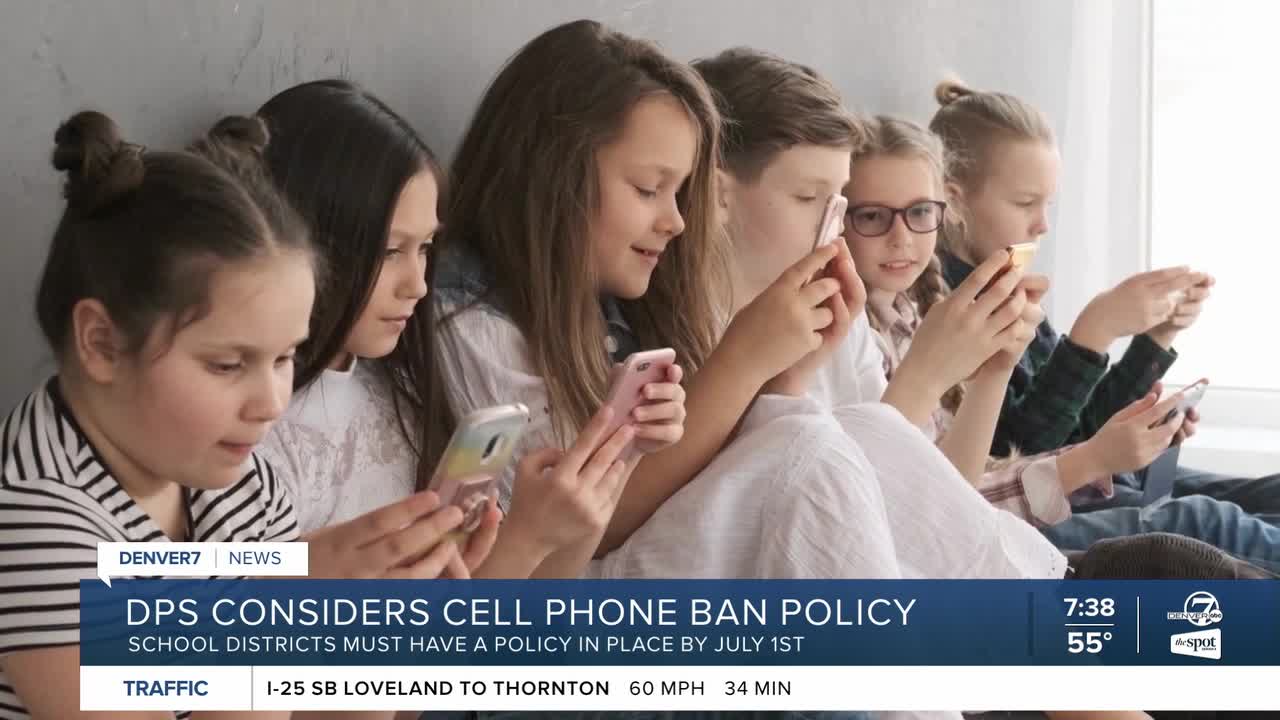


DENVER — Denver Public Schools could soon crack down on student cell phone use as the district’s board is considering a new districtwide ban on student communication devices — including cell phones and smart watches — throughout the entire school day.
“Currently, each school sets their own policy when it comes to cell phones. Many of those policies are already bell-to-bell,” Denver Public Schools director of external communications Scott Pribble said.
▶️ Watch: Denver7's Sophia Villalba reports on the potential ban
This push is partly because of a new Colorado law that requires school districts to have a cell phone policy in place by July 1.
“DPS is working to come into compliance with HB25-1135, which requires all Colorado school districts to develop their own plan," Pribble said. "The law does not direct how the policy is implemented, just that school districts have a policy.”
DPS said the goal is to reduce distractions and support student mental health. The proposal would require students districtwide to keep devices put away all day.
“These policies decrease classroom distractions and have shown to improve student mental health. Additionally, schools which have a similar ban in place currently report improved social interaction between students,” Pribble added.
Officials said research shows fewer phones in schools can mean better classroom engagement, improved mental health, and more in-person interaction between students.
“Teachers have shared that there is a marked improvement in classroom engagement when phones are not allowed,” Pribble told Denver7.
The proposal would also include devices like smart watches and wireless earbuds because DPS says those devices can also be used to communicate during class.
“Members of the Community District Advisory Committee noted that many students could easily 'get around' a simple cell phone ban by using smartwatches for the same communication purposes,” Pribble said.
There would be exceptions for students who need devices for medical reasons, translation tools, or other accommodations.
“The proposed policy has built in clear guardrails for students who must have devices," Pribble said. "This includes students with medical conditions like Type 1 diabetes who use phones to monitor glucose levels. Additionally, exceptions are granted if a device is part of a student’s Individualized Education Program or 504 Plan for translation tools or assistive communication. These needs must be documented and will be managed by the school nurse or special education team.”
Denver7 spoke to a DPS parent whose child is currently in high school. She said her main concern is not being able to reach her child during a school emergency.
“There's been too many times that my kids have called me to pick them up early because of perceived threats, and they've always come out to be true," said Tamika Galloway, a DPS parent. "The teacher should have the capacity to make policies in the classroom that the kids are paying attention, and they're not distracted by the phones.”

Denver7 took Tamika’s concerns to DPS.
“School offices remain the primary point of contact for sending messages to students. During an active-shooter situation, using a cell phone is not recommended because the phone noise and light can actually put students in greater danger,” Pribble said in part.
The district is still working through details like how the rules would be enforced and where students would store their devices during the day. DPS said storage systems could cost close to $1 million.
“The proposed policy calls for an annual review of the effectiveness and outcomes of the policy,” Pribble added.
The district is also asking for public feedback through an online survey that closes on Friday at 5 p.m.
According to Pribble, it will be up to the superintendent to implement the policy once it's established.
