

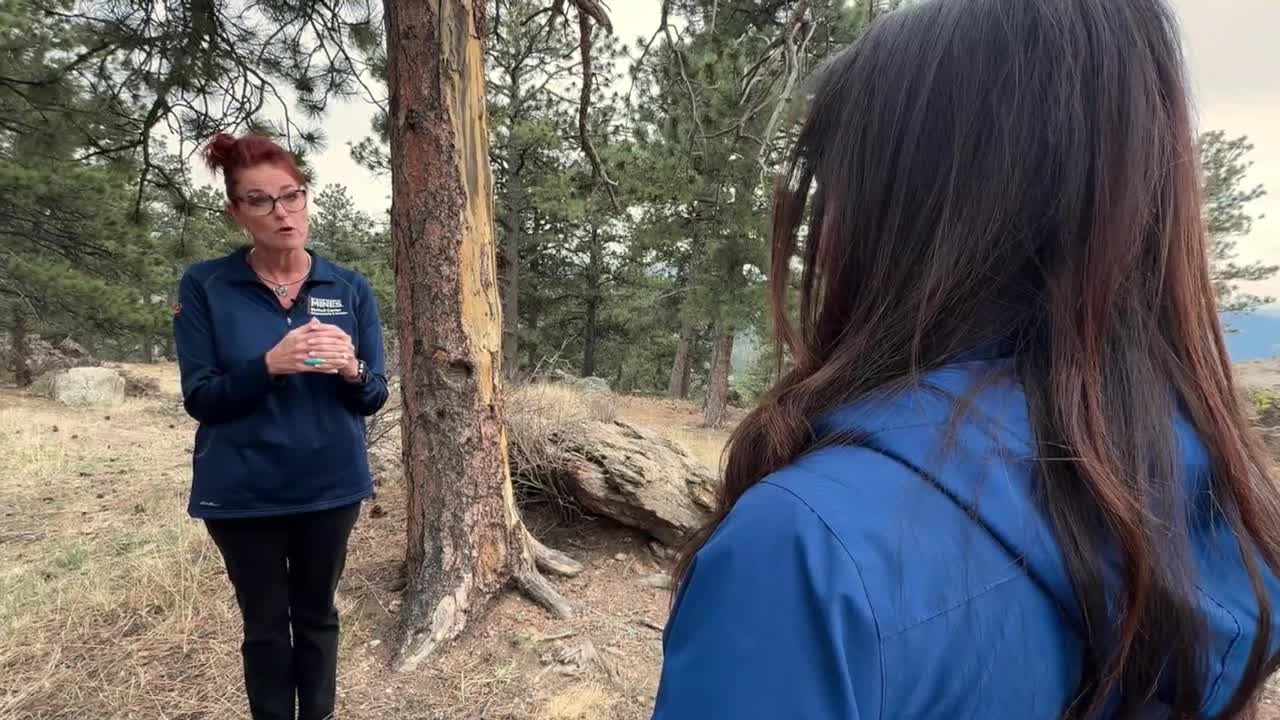


JEFFERSON COUNTY, Colo. - About a dozen students at Colorado School of Mines are putting the finishing touches on their real life concepts answering the question of what do to with all the flammable material left over after fire crews do mitigation work.
Their concepts are part of the Innov8x Biomass Challenge, where students create environmental and economic solutions to a problem. On April 3, the ideas will be presented to a panel of judges including a Jefferson County commissioner and Jason Puffett, division chief of Evergreen Fire's wildland division.
"We have one of the toughest geographies in the country, you know, in terms of wildfire risk," said Puffett.
▶️ WATCH: Denver7's Danielle Kreutter talks with experts and a student about the Innov8x Biomass Challenge
He said wildfire and forest mitigation is a constant battle for his team and others like them.
"We're looking at wildfire, we're looking at beetles," he said. "What we're seeing a tremendous amount of material being produced. How do we deal with this? We need to find a solution that has an economic component to, it so it's sustainable."
That's where the Innov8x Challenge comes in.
"We bring in industry, and we ask them for real problems, we frame it to our students, they have two to three weeks to come up with a solution," said Dr. Lia Franklin, acting director of the McNeil Center for Entrepreneurship and Innovation at Colorado School of Mines.
One of the ideas comes from freshman Hannah Rodda. As a highschooler at Calvary Chapel High School, she worked with conductor ink made with what's called "carbon black" as a base. That conductive ink was developed by a different student team through an earlier program at that school.

"On a circuit board, it connects the things together. Basically, if you took an LED and two batteries and used the ink to connect it, the LED should turn on," Rodda explained.
When she learned that pine needles contained a high amount of carbon, she realized that the same reason they are such a strong fuel during wildfires actually can make them a good replacement for carbon black.

"This is the completely bio charred version of the pine needles. It went inside a nitrogen tube furnace, and it was burned at 400 degrees Celsius," Rodda said. "It gets mixed in with some other things and fully grinds it up. It's just going to be acting as a binder, basically, and it'll be able to smooth."
The idea is to use money made from the pine needle conductive ink to help fund more mitigation work.
"Usually conductive inks, they're made of silver, and that's about $300 to $2,000 per kilogram, and this one is instead about $20 to $300 so it's a huge, like, price gap there," she said.
Puffett got a sneak peek of Rodda's concept during her Denver7 interview.
"I'm blown away — the creativity, the technical component," Puffett said. "It's going to be really fun to see what other ideas come to forefront on Friday."
The panel of judges will vote on winners, there will be a cash prize and the agencies may even work to implement the ideas.

