



LOUISVILLE, Colo. — The death of 91-year-old Mildred “Milsy” Roller was not just an assisted suicide, but a crime, according to Boulder District Attorney Michael Dougherty. He said the case marks the first time Colorado's medical aid in dying law is at the center of a criminal prosecution.
"It's a sad and tragic case," Dougherty said.
Officers with the Louisville Police Department said they found Milsy inside her room at The Lodge at Balfour, a Boulder County assisted living facility, with a bag over her head connected by a tube to a nitrogen gas bottle. Beside her was a suicide note with the date changed from Feb. 5 to Feb. 18, 2024.

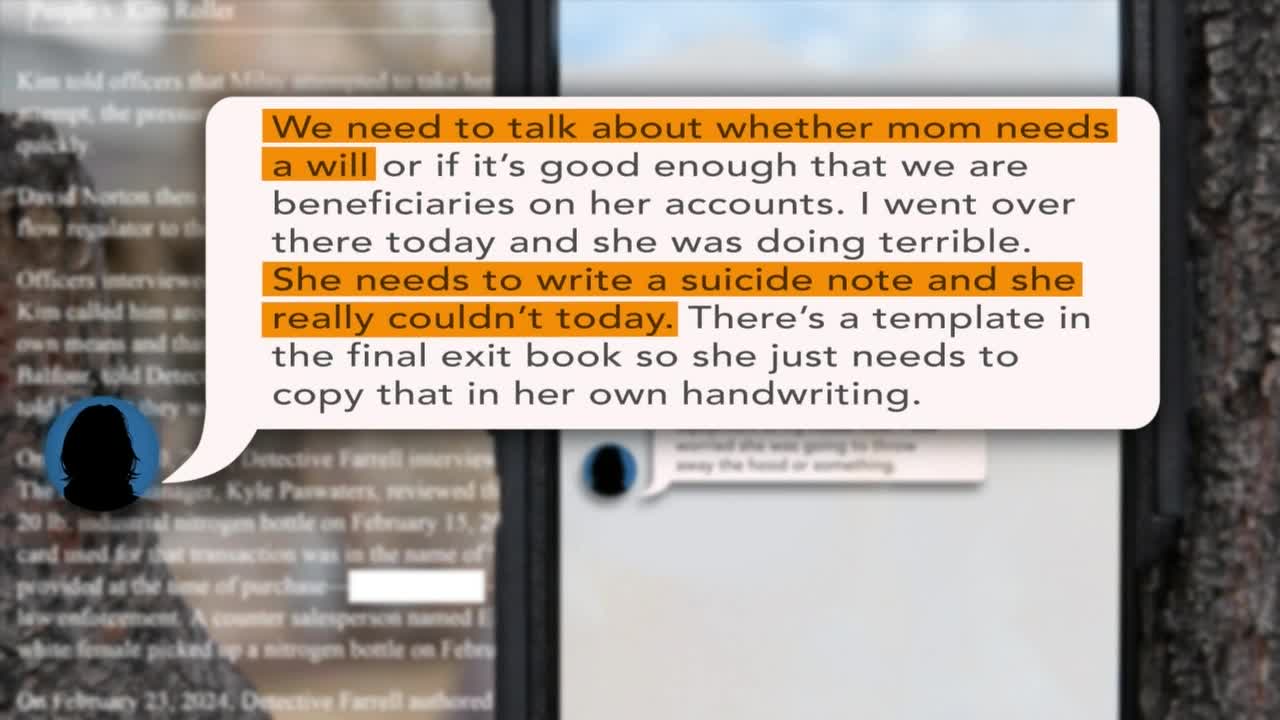
An indictment details text messages, purchases, and planning that prosecutors said crossed the line from the right to die into felony manslaughter. According to the indictment, texts included statements like, "We need to talk about whether mom needs a will," and "She needs to write a suicide note and she really couldn’t today."
"This is definitely about fighting for justice. And she doesn't have a voice in this process," Dougherty said.
Court records say Milsy's daughter, Kim Roller, bought a nitrogen tank three days before Milsy died. Kim's brother-in-law David Norton ordered a pressure flow regulator from Amazon and helped Milsy install it, according to the indictment. Prosecutors say there had been a failed suicide attempt earlier that month.

A Boulder grand jury recently indicted Roller and Norton on felony manslaughter (caused or aided suicide charges).
"We looked at it really carefully, but ultimately it's guided by the rule of law," Dougherty said of the lengthy investigation.
Colorado's medical aid in dying law requires a patient to be terminally ill with less than six months to live. The law also requires a medical provider to be involved to prescribe medication and a witness who does not stand to benefit financially.
"Those requirements were not followed in this case," Dougherty said. "And when the law is not followed, we have individuals who should be held accountable for violating the law.”
The indictment says Milsy had no terminal diagnosis and her family stood to inherit more than $650,000.
Police say Kim attended a Final Exit Network workshop weeks before Milsy's death at The Lodge at Balfour, the same facility where Milsy lived. Texts show Kim brought in gear to make sure they had the right equipment, stating, "We've got the right equipment. I brought it in a (sic) showed it to one of the guides."

Final Exit Network is a nonprofit, right-to-die advocacy organization that offers education and workshops on end-of-life choices.
"Final Exit was providing seminars all across the country and here in Colorado. And those seminars, as of now, are different in the state of Colorado," Dougherty said.
Dougherty said Final Exit has now agreed to change its Colorado workshops, making sure participants understand the law and cutting out step-by-step nitrogen instructions.
"It gets closer to the line where Final Exit could have committed the crime, and we looked at that very carefully as well. They did not in this case, but certainly that raised concerns for us," Dougherty said.
In a statement, Final Exit Network said it has not been charged with a crime, and the defendants were not clients in its formal exit guide program.
"We support the right of competent adults to choose the time and manner of their death. It is, however, illegal to provide any kind of physical assistance … such as purchasing equipment or assembling it for someone else — a fact we include in all our education efforts," Final Exit Network said in the statement.
You can read their full statement below.
"Here in Colorado, the takeaway should not be family shying away from using this option. The takeaway should be following the law when they do so," Dougherty said.
An attorney for Norton told Denver7 Investigates this was about honoring Milsy's wishes, not money, and said she was of sound mind.
The Lodge at Balfour said Final Exit workshops are no longer being provided at its facility, and the session in question was held at the request of residents.
If convicted of manslaughter by aiding suicide, Kim and Norton could face up to six years in prison. Both are due in court for arraignment in April.
Colorado voters approved a right-to-die law in 2016. The state tracks how many people have chosen this option, and those numbers have increased since the law passed.
In the video below, Denver7 Investigates' Jenn Kovaleski breaks down the elements of Colorado's assisted suicide law and data on its use in the state.
The state's health department reports that 510 people were given prescriptions for aid-in-dying medication by medical providers in 2024. That's a 28% increase from 2023.
The vast majority of those getting prescriptions had cancer.
In 2017, the first year after the law was enacted, only 69 people received prescriptions.
"Under the law in Colorado, there is really a specific list of things and requirements that people have to do in order to satisfy the medical aid and dying law," Dougherty said.

