

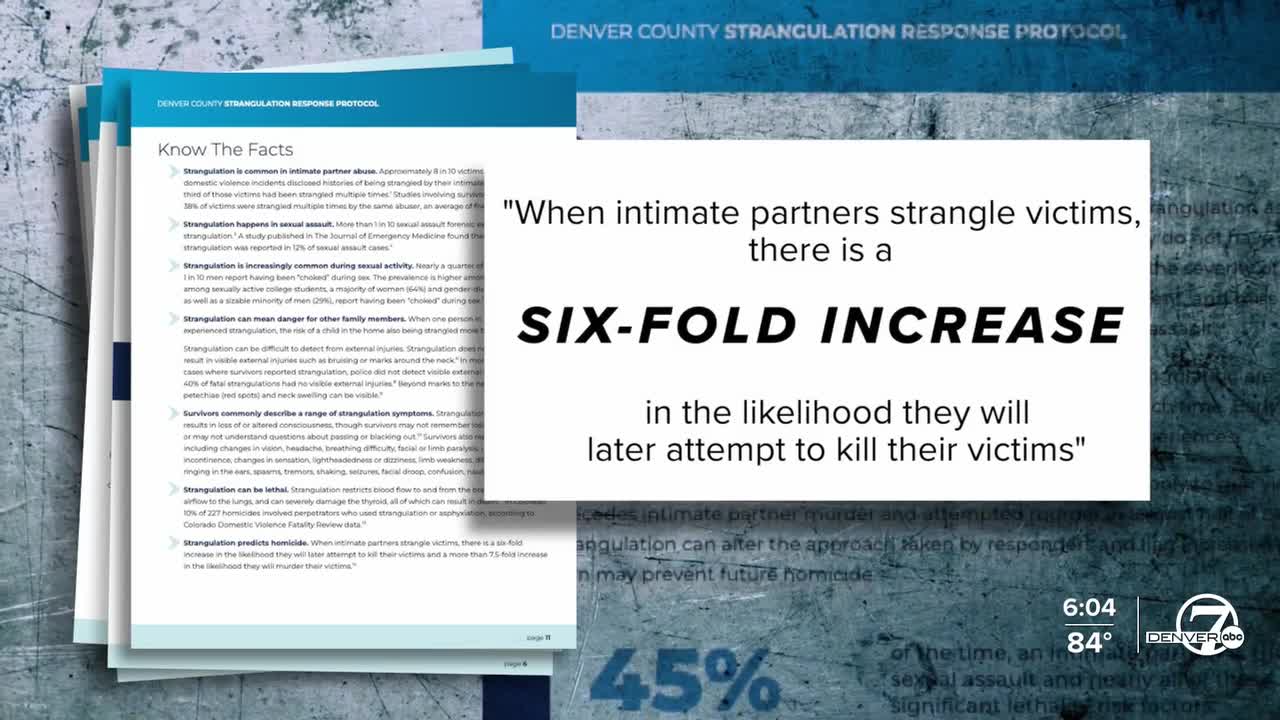


The Denver County Strangulation Response Protocol Committee has released a new report that highlights blind spots in responses to strangulation reports while also outlining changes to its protocol.
The committee includes prosecutors, medical professionals, law enforcement representatives, community advocacy groups, and more from across the area.
According to the report, strangulation is the second-deadliest form of assault, only behind gun violence, and non-fatal strangulation precedes intimate partner murder and attempted murder in almost half of the cases.
In the report, the committee outlined a variety of facts that people should be aware of when it comes to strangulation, including the importance of training.
The report also found that because strangulation doesn't always result in visible external injuries, it can be overlooked. The document reads that 17% of police reports failed to identify strangulation, despite describing assault characteristics and injuries consistent with it.
"Without information about the risks and consequences, survivors may minimize or dismiss the act, not disclosing the strangulation, especially if there were other, perhaps more visible outcomes from an assault," the report said. "Therefore, it is critical for responders to ask every survivor about strangulation, to encourage medical assessment, to provide information about safety and health risks, and to treat every strangulation case as high risk."
In December, Denver7 reported on a case where this issue was in the spotlight. Marina Placensia, a mother in Denver, was murdered in 2016 on an Amtrak train while trying to escape an abusive relationship. An expert on strangulation and suffocation reviewed the case and determined her cause of death was suffocation and the manner was homicide. After years of investigating — much of which included reviewing strangulation as a possible cause — the defendant stood trial in 2026. He was found guilty and was sentenced to life in prison without the possibility of parole.

Denver
Brother says justice served decade after sister's murder on Denver-bound train
Placensia’s murder illustrated how problematic strangulation can be in cases where the person has no visible injuries.
Under the report released Tuesday, officials outlined several protocols and operational elements that people in different agencies can take.
For 911 dispatchers, any domestic violence incidents involving physical altercation will require the Emergency Call Taker (ECT) to ask if the survivor(s) were strangled or "choked."
"The ECT can use direct questioning or an open-ended phrase such as: Was anything placed on or against the person’s neck or face by any means?" the report reads. "In situations where an individual was strangled, the ECT will utilize the mandatory shorthand command/STR which translates to <<Possible strangulation involved>>, to aid in documentation that strangulation was reported as part of the incident."
Also, the Denver City Attorney's Office will have an automatic escalation when strangulation is involved.
"The Denver City Attorney's Office's (CAO) protocol is to review all domestic violence cases and, when strangulation is noted in the police report, to staff that case with the District Attorney's Office (DAO) for consideration of an up-file to a state-charged case. If accepted, the case will go to the District Attorney's Office for prosecution. If rejected for a misdemeanor or felony filing, the CAO will prosecute the case and handle it as a high-risk situation," the report reads.
Investigators will also have to schedule follow-up photographs within 24-48 hours to document any delayed bruising.
You can read the entire report below.

