

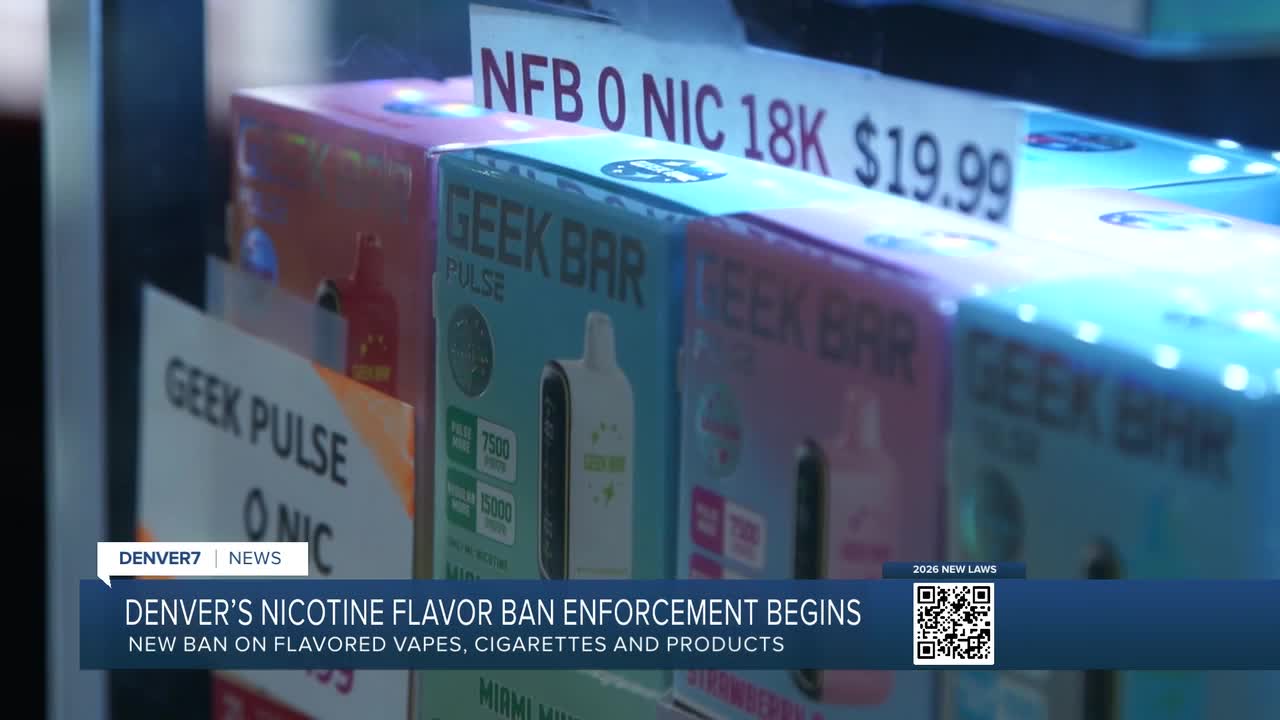


DENVER — The ban on flavored nicotine and tobacco products in the City and County of Denver officially went into effect on Thursday, Jan. 1, 2026.
Denver voters chose to keep the ban in place back in November, when they voted in favor of Referendum 310.
As of Thursday, some 575 Denver retailers can no longer sell flavored nicotine and tobacco products.

Kristen Hensel, who owns two Rusty's Vape & Smokeshops — one in Denver, the other in Commerce City — is now faced with the reality of barren shelves at one location.

"This is our vape section where we sold adult smoking cessation options for people to quit smoking," Hensel said. "As you can see, it's completely cleared out. 50% of our business is going to be gone, as well as 100 other shops like I mentioned. They're going to have the same problem."

Hensel told Denver7's Veronica Acosta because the ban went into effect when the clock struck midnight Wednesday into Thursday, she cleared the newly banned product then.
"Last night, on New Year's Eve, you know, essentially going into the new year, dismantling my business," she said.
Hensel told Denver7 that last year she made roughly $750,000 in sales off flavored nicotine products. Those are now sales she's working to figure out how she'll make up as 2026 begins.
"We're going to be evolving and, you know, spreading our smoke shop inventory, expanding as a smoke shop," she said. "We're going to try to have an online presence for our smoke shop."
"We're pursuing other options outside of Denver," she added.
Hensel also admitted she's one of the lucky vape and smokeshop owners because she has another location outside of Denver. She said she was able to relocate unsold flavored nicotine products to that store.
It's an option many Denver vape and smokeshops simply don't have.
"I feel a little numb," Hensel said. "I feel a little angry, because it's kind of unfair."
According to the City and County of Denver, enforcement on the ban begins on Jan. 1, 2026, which is when Denver's Department of Public Health and Environment will begin "issuing fines and suspensions to retailers found selling flavored tobacco products."
DDPHE is responsible for enforcing the ban, which will be done primarily in two ways, through routine and undercover inspections.
Routine inspections will require the department "conduct regular inspections of tobacco retailers to ensure compliance with tobacco laws, including those related to sales to minors and signage requirements. These inspections will include checks for the sale of flavored tobacco products."
Undercover inspections will require DDPHE "utilize undercover operations, including 'Undercover Buy' inspections conducted by Local Tobacco Investigators and Youth Operatives, to identify and address violations."

