

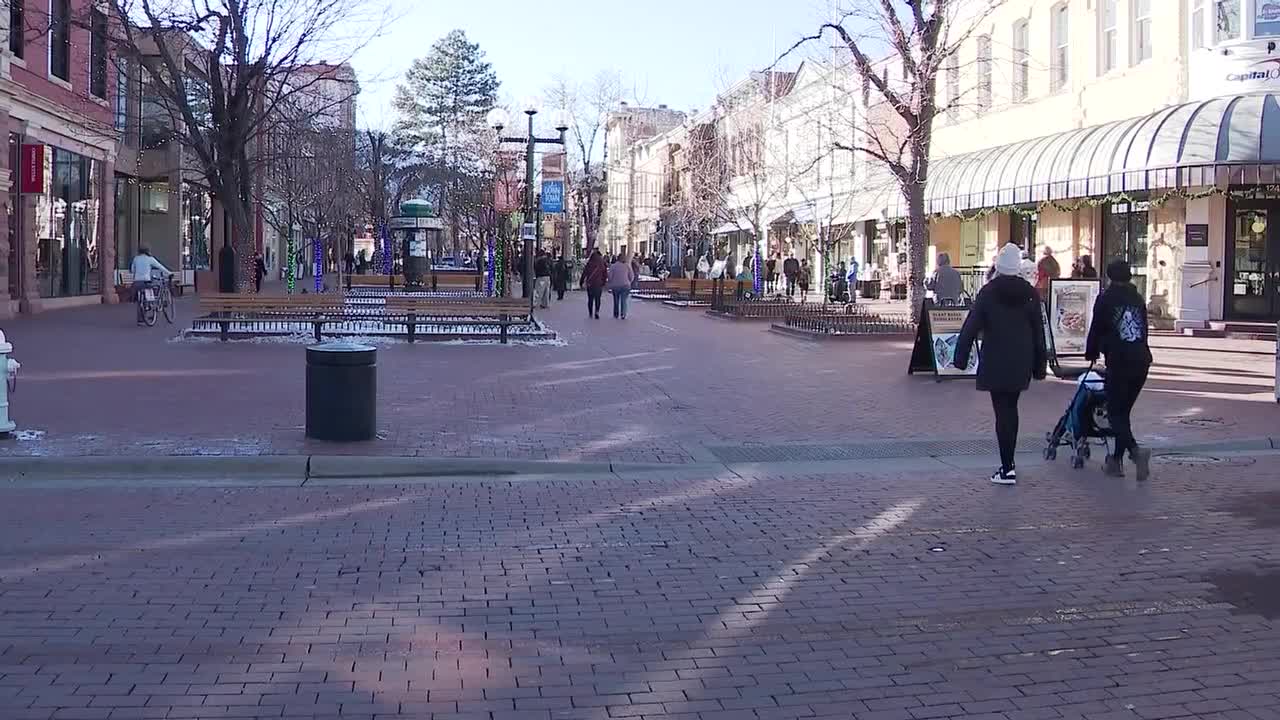


BOULDER — Almost six years have passed since the start of the COVID-19 pandemic and downtown Boulder still faces a "historic" commercial vacancy rate, according to experts working closely on the complex issue.
"Real estate is, if not the No. 1, it's the No. 2 question that we have," said Jonathan Singer, senior director of policy programs with the Boulder Chamber. "Right now, we are looking at a historic commercial vacancy rate. Not just in our community, but across the world.”
The number of empty buildings throughout the city, with "for lease" signs hanging in their windows, is all Max Lord can see as he drives around Boulder.
"Vacancy. Vacancy. Vacancy," Lord said, pointing as he drove along. "There's a joke in my video that I'm like, 'Once you notice it, it's actually kind of creepy.' But it's true."
Lord, who owns a local construction business, recently posted a social media video about the sheer number of signs in vacant windows. The video begins with Lord standing near a sign for the Dark Horse, a beloved bar in Boulder which is set to be demolished as part of a redevelopment plan that includes both residential units and commercial space.

It's a scenario Lord finds ironic, and a social media video that garnered thousands of views.
“It clearly, really struck a chord. It reached a lot of people... People are seeing a lot of old legacy buildings disappear, and I think they are seeing a lot of new, empty buildings pop up," Lord said. "And they want to understand: What is the root cause of this?"
Lord offered up a handful of reasons he believes are part of the multifaceted problem.
"Part of it is that Boulder has been intentionally zoned to be very difficult to live in to keep it small. And that has historic roots in prejudice. It has historic roots in wealth," Lord said. “When we're dealing with a recession and it's harder and harder to do business in town now, we still need to go through all of these zoning loopholes just to operate. And so they kind of shot themselves in the foot a little bit on that.”
While there is no single answer that entirely explains the high commercial vacancy rate in Boulder, Singer said it started with the pandemic. Compounded with the increasing cost of doing business and the time the permitting process takes in Boulder, Singer said the situation has been exacerbated.
“If you want to start a business, you've got a great idea, and you want a place to do that work, you've got to get that business permit and that planning permit going quickly," Singer said. “You're sometimes looking at what looks like a confusing telephone book of rules and regulations. And when you've got a beautiful idea, you deserve every opportunity to be able to figure those things out quickly. We have examples in other communities where they're speeding things up. So, it's time for a little bit of copy and paste with a little bit of Boulder innovation.”
According to a spokesperson with the City of Boulder, their most recent economic indicator report showed a downtown Boulder office vacancy rate of 28.9%, compared to 17% for East Boulder and 13.7% for Central Boulder.
Singer explained that means roughly 30% of the offices in downtown Boulder are "empty, underused, or people are waiting to get in, but can't get in because of permitting issues.”
In addition, the Boulder Chamber Economic Council Report provided to Denver7 states "Boulder's office vacancy challenges have extended into the second quarter... with downtown vacancies spiking to a concerning 43%."

Jill Grano, a residential real estate agent, said retail vacancy rates are at "historic norms" while commercial office space vacancy rates are "way out of whack."
"That is going to be the most common talking point you hear, is the pandemic changed how we work. Boulder is tech heavy. Ninety-six percent of tech companies now offer remote work options," Grano said. "But the crisis really has to be looked at as multiple interlocking factors. So, how we work changed, but you would think then that at 30% vacancy, prices would start to drop, and they haven’t.”
According to Grano, there ought to be solutions to fill the empty spaces again. But she would also like to see an understanding of the "structural issues keeping the prices fixed."
"Our downtown office space is owned by big institutional investors with Commercial Mortgage-Backed Security loans that fix them at price assumptions from 2019," Grano said. "It's something that in the academic world we call third-degree path dependence, where the economic systems and norms from the past are locked into place, even when they're more expensive.”
Specifically, Grano identified the rental prices as an issue.
"The rent is something that really is the core problem, right? The law of supply and demand still works. If rent were to go down, it would fill up," Grano said.

Meanwhile, the operations manager at Tebo Properties, Ben Myers, said demand is their biggest challenge for their office spaces.
“Not many companies are wanting to come back to the office. And we would love to get all of our office spaces filled, because that's going to benefit our retail and restaurant tenants as well, especially in downtown Boulder," Myers said. “We would love to get tenants in our office buildings and get the spaces full. It definitely hurts the bottom line."
Myers said Tebo Properties owns a majority of retail spaces, with offices accounting for an estimated 20% of their business. Myers blamed the pandemic for the spike in commercial office vacancy rates.
"Who knows if it'll ever be where it was before, but we're trying our best to try to get these spaces filled," Myers said. “People can work from home, and a lot of companies are still fully remote or hybrid. So, a tenant that was looking for 10,000 square feet of office before is now only looking for 2,500 square feet of office.”
Denver7 asked Myers if the company has lowered their rent prices in response to the vacant offices.
“We've definitely adjusted our rates to try to attract more tenants to come back to the office. It just feels like there's not much demand," Myers said. “Our property taxes, which kind of get passed through to the tenant, the small business — those haven't really adjusted either. So, it's been a challenge.”

Singer said the Boulder Chamber and the City of Boulder, alongside Boulder Together, are working together to identify examples of other cities that have successfully reduced their office commercial vacancy rate.
“It's everything from finding small business assistance — so the places that don't have big lawyers or can't afford to pay for those planners can actually get in through the front door and know what they're doing — to creating new opportunities with our new city council to look at how we create a new plan for our small and bigger businesses too," Singer said. “Our Boulder Together Initiative and the Commercial Brokers of Boulder have merged with the Boulder Chamber now. So, we've got landlords and tenants working together to create these new solutions."


