



The headwaters of the Colorado River were not what Mina Guli expected them to be.
She had imagined a big, bubbling brook that appeared out of the ground or spouted from the side of a mountain. Instead, she found herself traipsing through a bright green meadow in Rocky Mountain National Park, surrounded by mountains that should have had more snowpack, with navigation apps in hand.
“Then there's this point where all these tiny little channels, we're talking like channels that aren't even as wide as your hand, all start to join together to become like this little bubbling stream,” Guli says. “That is the start of the Colorado River.”
That unassuming start of the very big river also marked the start of the Australian ultra runner’s very big quest to run the entire length of the waterway in 100 days — a 2,000 mile journey taking her through Colorado, Utah, Arizona, Nevada, Mexico and California.
Just as those tiny channels grow into something more powerful, Guli hopes each step she takes will build energy for protecting this mighty river.
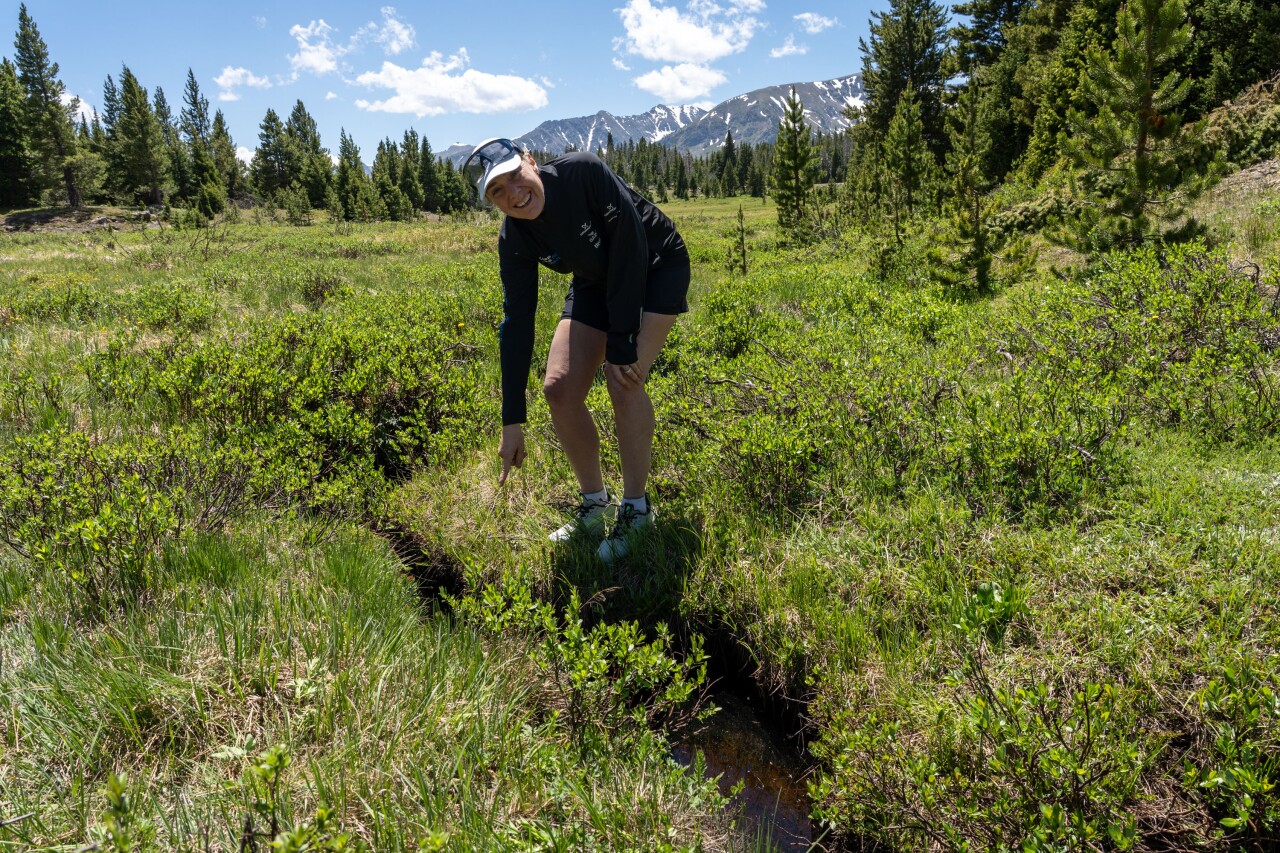
“Every single time I go and run a marathon, it's not a marathon. It's a multitude of steps, but every single step counts,” the 55-year-old told Denver7 from a campsite in Utah just after setting up camp for the night 26 days into her journey. “Every small step in the right direction creates forward momentum, and forward momentum is what the river needs right now.”
Guli, who founded the water nonprofit Thirst Foundation in 2012, has lived through “incredible drought” growing up in Australia and has seen the consequences firsthand. It’s something she says she doesn’t want anyone else to experience.
She previously ran 200 marathons in one year ahead of the 2023 UN Water Conference to raise awareness on global water stress. Now, she's running close to a marathon a day for 100 days for the Colorado River.
“[The Colorado River] supports $1.4 trillion of economic activity. Over 40 million people depend on the water from this river,” she said. “It is one of those rivers where if we can't get this right, what hope do we have for other rivers around the world?"
About 95% of the Colorado River Basin is currently in a drought, according to the national drought monitor, and the river’s two largest reservoirs — Lake Powell and Lake Mead — are expected to reach new historic lows every day until spring, according to an analysis from Colorado River experts published last week.
On the day Guli talked with Denver7, she was 26 days into the 100-day journey and had already seen the reality of those statistics firsthand.

She’s stood at Lake Powell and seen the water level the equivalent of a multi-story building below where it should be. She’s crisscrossed the river on foot where she had expected to packraft, leaving the raft in her crew’s car.
“I am absolutely shocked, horrified, and heartbroken at how sick this river really is,” she said. “It is very hard to explain just how low the flows are until you've seen it, until you have stood on the riverbank with your feet in mud, looking at where the river should be, and seeing where it is now.”
"It is devastating," she added. "We didn't have to be here, but here we are.”
Doing hard things
Guli describes the journey itself as a rollercoaster — one with highs and lows and unexpected twists and turns.
She’s experienced awe-inspiring nature, an ever-changing landscape of grand mountains, towering cliffs, extreme desserts and green forests.
But as drought plagues the basin and creates a tinderbox, fires have required unplanned detours. She had to reroute because of the Snyder Fire, which forced evacuations from the river corridor and charred more than 30,000 acres near the Colorado-Utah border, and then again later for the Babylon Fire in Utah, one of the country’s largest wildfires so far this year at more than 107,000 acres.
Running around the Babylon Fire, Guli and her crew could see the red blaze at night and “nuclear mushroom clouds” of smoke during the day.
As the extreme conditions and distance rub her nerves raw, the reality hits even harder.
“When you do these long distance events, you also become very much more emotionally vulnerable because you're exhausted all the time, and everything gets stripped away,” she said. “Physically you break down, mentally you break down. Emotionally, you break down.”

Her feet are blistered, and she's faced challenges with altitude after coming from sea level. Day after day, she has run through triple-digit, “diabolical” heat, with little relief in her tent at night.
She insists she's "really bad at running," saying "I'm old. I break down. I'm like the slowest person on the planet. I find it really hard to navigate across rivers. I fall in."
She’s cried tears of frustration and tears of sadness. But for Guli, the trying conditions are the whole point.
"This is hard," she said. "But the other thing I remind myself is we can do hard things, whether it's running 2000 miles down the Colorado River, or whether it's sitting in boardrooms and holds the power of government and making the decisions that need to be made to protect and preserve and create a resilient river basin. They're all hard, but I know that when we work together, we can make them happen."
‘Change is made by communities'
As she traces the river, she’s talked with farmers, ranchers, raft guides, anglers and all manner of people who rely on the river. Each night, she writes in her dairy, keeping a log of the people she meets and the stories they tell her.
“All of them have said the same thing: the river is in a dire place, and that means that their businesses are suffering,” she said.
She’s also experienced “incredible kindness, interest, and passion of a local community for this river, and the desire of all of them to see a much more resilient river and river basin.”

Along the way, people have pulled over to ask if she’s OK and offer her water. One family gave her a whole sheet of popsicles — called icy poles in Australia.
Guli said her curiosity to stop and talk with locals along the way often pushes her runs later into the hot days.
“Change is made by communities of people working together,” she said. “And when I witness the power of the people, when I witness the desire for them and by them for change, I'm like, what is it going to take for these politicians and bureaucrats and people in positions of power to listen to the people?”
Throughout the journey, she’s taking the stories she hears to people in power through summits that bring together policymakers, scientists, water managers, Tribal leaders and business stakeholders.
But it’s not just people she’s gotten to know.
“The river is my friend now,” she said. “I've run by it for thousands of steps, and it's become my friend. We talk, we cry, we laugh, we share experiences together.”

Now, more than 30 days into her journey, she’s entering the Grand Canyon where extreme heat will often require hiking through the night, carrying everything she needs on her back. In a video posted Friday, she said it’s going to require skills she doesn’t have, but is going to have to learn.
“I don’t know quite how to explain to you how scared I am, but I’m going to do this,” she said in the video. “I’m going to keep reminding myself I’m not a mouse, I’m a lion, and just focus on getting this thing done, one step in front of the other.”
She doesn’t know what lies ahead, but she’s sure of one thing.
“No matter where I go, no matter what I do, for the rest of my life,” she told Denver7, “this river will be a part of who I am.”