


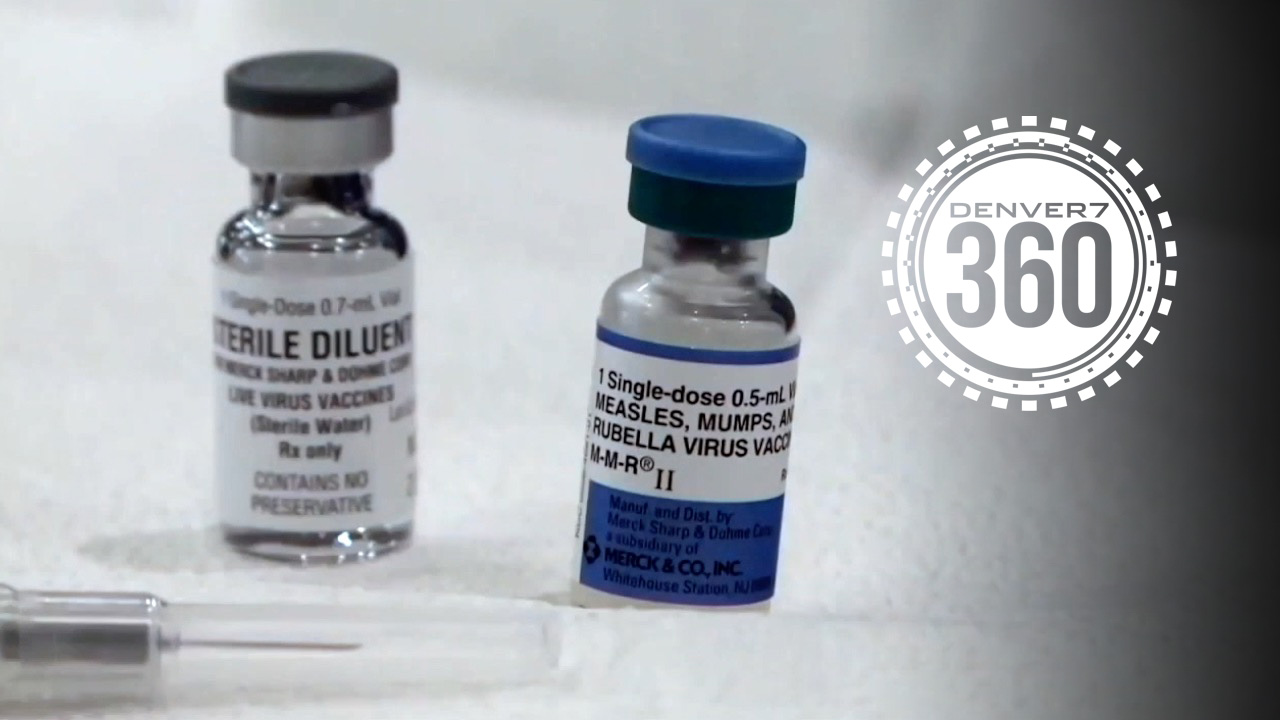


DENVER — A tourist infected with measles could have exposed thousands of people to the highly contagious virus at Denver International Airport earlier this month, state health officials said Tuesday.
The individual arrived at gate B45 in the B Concourse at 7:24 p.m. on Friday, Dec. 12, and departed from Gate B84 in the B Concourse at 9:41 p.m., a spokesperson from the Colorado Department of Public Health and Environment (CDPHE) said in a news release.
Because the infected passenger is fully vaccinated against the virus, the risk of spreading the virus to others is lower, but still possible, the CDPHE spokesperson said, and added that passengers who were exposed to the case on either of the flights will be notified directly by their state or local public health agency.
What to do if you believe you were exposed
Anyone who believes they may have been exposed — especially those who have not been vaccinated with the MMR vaccine — should monitor for symptoms for 21 days and avoid public gatherings or high-risk settings, health officials said in a news release.
In this exposure, state health officials said those who were potentially exposed may develop symptoms through Jan. 2, 2026.
Symptoms to watch out for include anything from a fever, a cough, a runny nose, and red, watery eyes that develop into a rash that starts on the face and then spreads to the rest of the body about three to five days after symptoms first start. A person with measles is contagious four days before and four days after the rash appears.
While most people recover within two or three weeks after contracting the virus, unvaccinated people run the risk of complications from the disease, including ear infections, seizures, pneumonia, immune amnesia, brain damage and ultimately, death.
Measles only spreads from people who show symptoms; it does not spread from people who aren’t feeling sick, state health officials said.
- Denver7 has been closely following confirmed cases of measles in Colorado amid a multi-state outbreak of the virus in the U.S. this year. Explore the timeline map below to see more on where cases have so far popped up:
Unvaccinated people exposed to the virus can get the MMR vaccine 72 hours after exposure (but before symptoms are present) to prevent an infection, according to health officials. Immunoglobulin (IG), if administered within six days of exposure, may also be used in some circumstances, they added.
“Getting vaccinated is the best way to protect yourself, your family, and your community,” the CDPHE spokesperson said.
While the two-dose series of the MMR vaccine has a 97% efficacy rate against infection, about 3 in every 100 people can still get infected if exposed to the virus, according to the U.S. Centers for Disease Control and Prevention (CDC). Vaccinated individuals will usually develop milder symptoms and are less likely to spread it to others, according to state health officials.
People who got vaccinated against measles before 1968 should talk to their health care provider about possibly getting a booster as the vaccine used before that year wasn't as effective.
Colorado experiencing worst measles outbreak in 30 years
This latest case marks the state's 33rd so far this year amid a multi-state outbreak across the country.
The last time Colorado saw this many cases of the virus was in 1995, when the state reported 26 for the whole year to the U.S. Centers for Disease Control and Prevention (CDC). On average, Colorado sees between zero and two cases each year.
As of Dec. 15, Colorado has confirmed cases of the virus in Adams (4), Arapahoe (5), Archuleta (1), Boulder (1), Denver (4), El Paso (4), Mesa (11), Montezuma (4), Pueblo (1), and Weld (1) counties. Most have been in unvaccinated individuals.


Denver7 is committed to making a difference in our community by standing up for what's right, listening, lending a helping hand and following through on promises. See that work in action, in the videos above.