

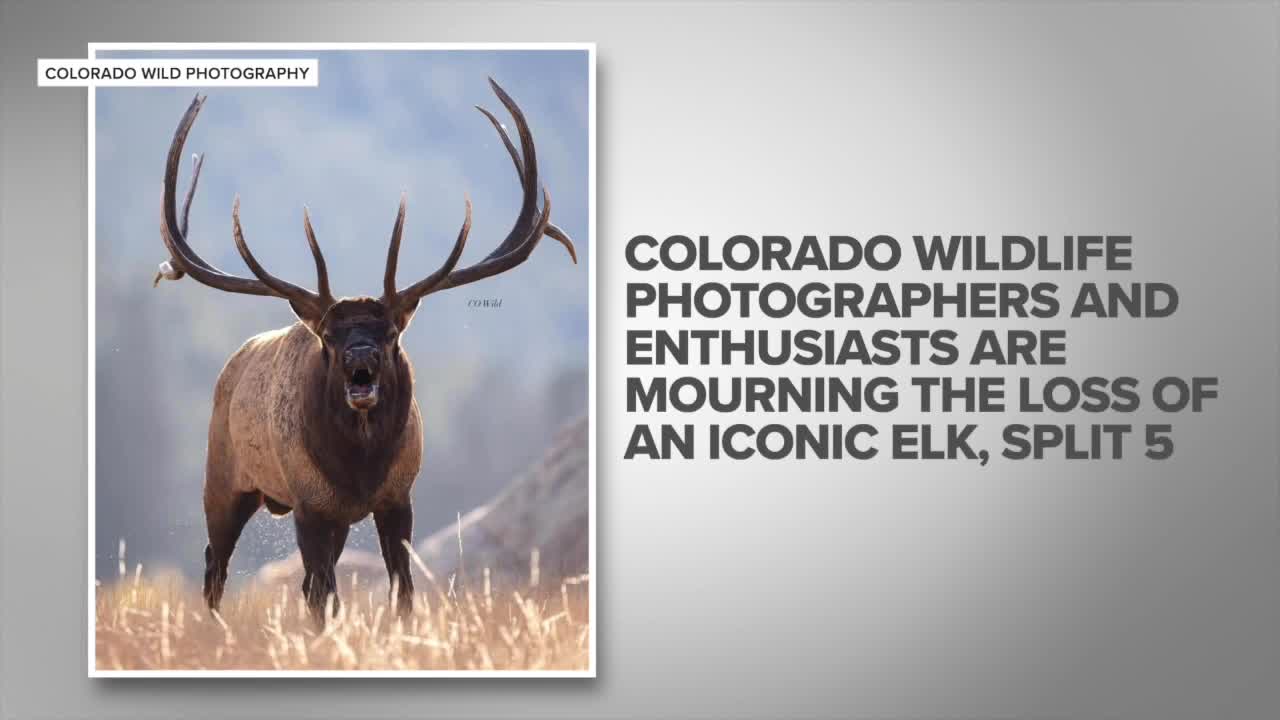


ESTES PARK, Colo. — Wildlife photographers and enthusiasts in Colorado and beyond are mourning the reported death of Split 5, an iconic elk heralded as Rocky Mountain National Park royalty for years.
The bull – named Split 5 for the split in the fifth tine on both of his massive antlers – has long drawn the lenses and eyes of visitors and locals alike for his imposing stature, dominance of the rut and unique personality.
The belief in that community is that the famous elk was legally hunted and harvested in October. Colorado Parks and Wildlife couldn’t confirm the killing since elk hunters aren’t required to report harvests to the agency.
Split 5 was known to arrive in Estes Park in June and leave in October, according to one photographer who has followed the elk since 2019. The bull may have been hunted at or near his wintering grounds outside of town.
- Hear from a photographer who's followed Split 5 for years about what the elk meant to the wildlife community, in the video player below:
Hunting is illegal inside Rocky Mountain National Park, and a park spokesperson said they couldn't confirm Split 5's death.
As word of the elk’s passing spread this week, tributes poured in on social media from fans across the region.
Denver7 caught up with one of the loyal photographers in the station’s Discover Colorado | Through Your Photos group on Facebook who has documented Split 5’s activity for years.
"He was in charge of his own fame,” said Stephen Branum, who operates the photography account The Untamed View and leads guided tours of Estes Park. “I mean, it's Rocky Mountain National Park. We have over 5 million people come through here annually, and a lot of people just are like, ‘Oh, I hope we see [Split 5]."
Branum says he’s in the park most days, often looking for Split 5 himself and regularly fielding requests from others to catch a glimpse of the well-known wapiti. He tells us he’s had tour cancellations from prospective visitors hoping to see Split 5 who have heard the news.
Social media has helped drive Split 5’s fame, said Branum, who has shared countless photos and videos of the bull that have captivated his roughly 150,000 followers across Facebook and Instagram.
“It’s not just nationwide, that would be worldwide,” he said. “[I have followers from] so many nations that are like, ‘Oh, we saw him,’ or, ‘We've been watching him [...] He’s just that recognizable.”

Never a shortage of cameras
Branum said some photographers would travel hours to get to the entrance to Rocky Mountain National Park in the wee hours with hopes of first dibs on finding Split 5.
He had command of the herd – other elk would scatter at just the sight of the massive bull, Branum said – and of the moment. While his majesty has been captured in stoic forest scenes or amid his harems during the fall rut, he was also known to hang out by the YMCA of the Rockies in Estes Park, unbothered by surrounding crowds.
In one clip Branum shared with us, Split 5 can be seen taking a nap on a busy baseball field.
No matter the scene, camera lenses were likely to be nearby.
"He was the entertainer, not me,” Branum said. “I'm just there with a camera to capture some of these moments."

Those moments will be missed by Split 5’s fans, he said.
"With him being gone, those of us who are with him daily, weekly to see him and see what he's up to [...] we're not going to get to see that again,” Branum said. “That kind of sucks."
Complicated feelings about the end
Split 5 was also known as Atlas for his rack of antlers that looked like it could hold the world. He’s believed to have had what’s called a 400-class rack, marking an extraordinary size based on nuanced measurements known in trophy elk circles.
But he likely wasn’t hunted for his impressive crown.
Split 5’s followers estimate him to have been about 12 years old. The typical lifespan for an elk in the wild is 10-13 years, according to information published by Estes Park.
That’s a lot of ruts, during which bulls battle each other over cows. The last rut seemed to take a toll on Split 5, who was photographed with broken antlers and was seen with a limp in his final weeks, Branum said.

His death coming at the hands – or the weaponry – of a hunter has stirred up plenty of reaction in the wildlife community.
Those who are supportive of elk hunting may say it’s a necessary means of population control and a meaningful food source. Hunting license fees also help fund wildlife conservation and management projects in Colorado.
Hunting critics would argue that nature is capable of regulating itself, that the sport is disruptive to natural selection or that harm to animals is ethically unsound. There is, of course, also the emotional draw to a beloved animal like Split 5.
Others who fall in between the two sides of the debate may take solace in the fact that Split 5 likely didn’t feel the pain he would’ve had he gone by way of wolf, mountain lion, vehicle or disease.
“He was still a wild animal, and he still went 12 full years staying away from some of the dangers that animals have across the country, across the world,” Branum said.
Who’s the next king?
Split 5 was the most recent bull to reign as “king” in Estes Park.
Decades ago, an elk named Samson was known as the dominant bull. He was illegally poached in the 1990s but is immortalized by a statue at the entrance to Estes Park.
A bull named Kahuna became the most famous in the herd after Samson, and was a draw to the town, Branum said. Kahuna died of natural causes.
After Split 5’s reign, elk admirers await the next bull to take over.
Branum said the leader in the clubhouse is a bull known as Kahuna Jr. or KJ.
"Kahuna Jr, who a lot of us feel like – and nature decides – but he [...] was the dominant bull,” Branum said. “Split 5 was getting older, but [KJ] was the show during the rut last year."

-
Do you have a Discover Colorado story idea you want told? Shoot me an email: Landon.haaf@denver7.com